News
Resource efficient production
Nature management with military tanks
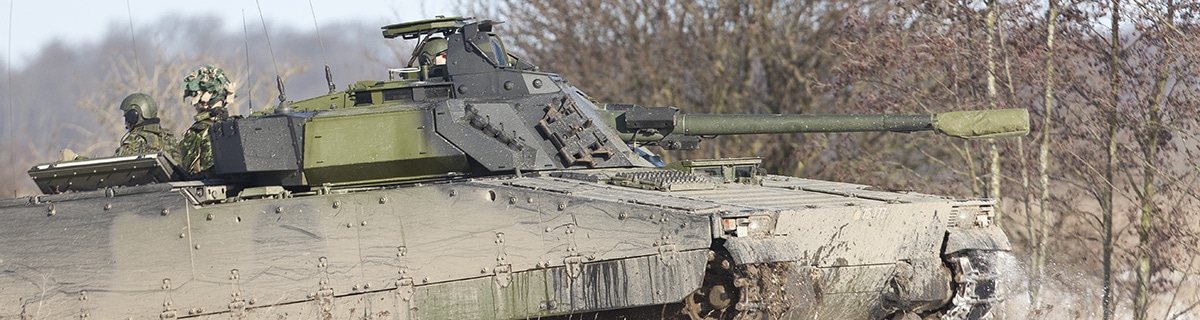

The Danish Armed Forces manages a large part of the Danish countryside, so why not make use of military resources, such as tanks and explosives, to manage the land? The Armed Forces has just drawn up a project catalogue to show the way for effective nature conservation, particularly with regards to training exercises.
Defence firing ranges and training areas comprise about 330 square kilometres in Denmark. Maintenance of the areas can be costly, partly because of the Armed Force’s own claim to the land, and partly because at least half of them are nature areas protected by law. Against this backdrop, the Defence Construction and Facilities Management Service (FBE) signed an agreement with a consortium consisting of Orbicon, the Danish Hunting Academy and Faunaforst, to prepare an ideas directory to identify and record opportunities for combining land management and conservation with Armed Forces' training and other activities.
Take advantage of the Forces
The army needs a variety of different terrains, varied landscapes with both open and overgrown areas.
Tanks can help to uncover mineral soil and keep growth down, TNT can fell trees and training in mine clearance may also contribute to clearing invasive species, etc. Elsewhere, non-military means such as year round grazing may also be in use.
Frogs in the caterpillar tank tracks
Steffen Michael Thomsen at Orbicon has a Masters in Forestry and he sees many opportunities for synergy between army exercises and land management.
- The Armed Forces create a unique type of natural environment when they conduct exercises today. A tank track is a shining example for many frogs that just need temporary ponds to breed in. An exercise in blasting, which fells a tree, can be a good thing for many animals and fungi as dead trees provide important habitats. Therefore, you can go a long way towards conservation when you think of military activities as nature management.
Better and cheaper exercise areas
Henrik Olsen is Land Manager in the Nature section of the Defence Construction and Facilities Management Service. He sees two reasons for this special form of land management.
- Today, we maintain exercise areas in order to ensure that the soldiers can train in areas that are as similar to their workplace as possible. The terrains are very varied in nature, and a fragile environment can limit training if there is a risk of the tanks damaging vegetation. By combining training activity with the natural need for land management a synergy can be achieved that achieves savings while also providing a better exercise environment.
Great interest from military personnel
- There has been a lot of cooperation all round, and there has been surprisingly strong interest from military personnel. To see the birds, plants, etc. suddenly become interesting for military men, and to see them realise the sense in combining exercise and nature management to save resources, has been an exciting process, says Steffen Michael Thomsen from Orbicon.
You should consider reading
Solution
Circular business models
+15