News
Resource efficient production
Waste management
Europe needs to improve its waste recycling rates
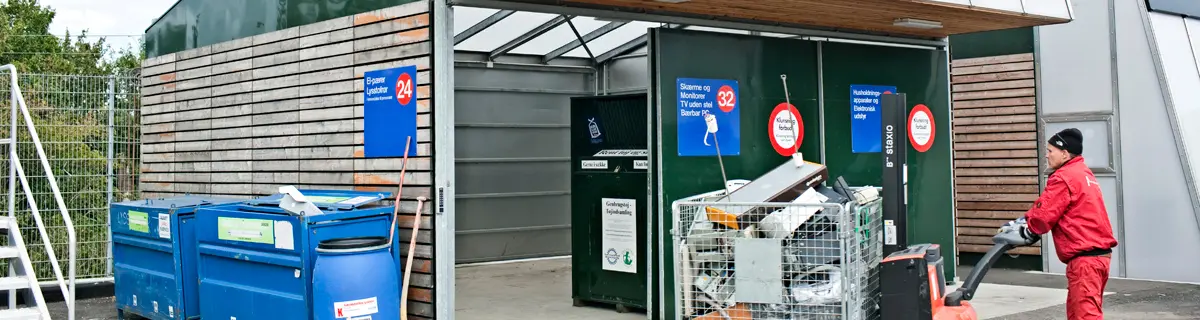
When you toss empty food tins, apple cores and plastic tubs in the bin, a large share of this rubbish is actually recycled for new purposes. In 2015, Denmark recycled 46 percent of household waste, but we need to increase these rates even further. At this very moment, the EU Council of Ministers has implemented new binding goals regarding waste recycling, thus paving the way for a future Europe that practises resource efficient waste management.
- Common ambitious goals are necessary in order to ensure everyone gets better at reusing resources. My experience is that most Danes are willing to do their part, and are eager to contribute, given the chance. This makes me very happy, as everyone needs to participate, if we are to achieve our goals, said the Danish Minister for Environment and Food, Jakob Ellemann-Jensen.
-Related news: The Recipe to Become a Green Frontrunner in Plastic Packaging
Bringing citizens, municipalities and the business community into play
The six directives, which have been adopted by the EU, establish common EU goals within categories such as waste, packaging and landfill. Citizens will experience enhanced opportunities for sorting waste, municipalities will play a large role and the private sector will be required to produce recyclable packaging.
There are large environmental gains to be made from recycling and reusing materials in new products, as it removes the need to extract and produce new virgin materials. Danes want to sort their rubbish and we’re getting better at it each year – and will continue to do so. Denmark has already met some of the new EU targets but others are more challenging, however not impossible, said Jakob Ellemann-Jensen.
Going forward, all EU countries will have to calculate their reutilisation rates in a strict uniform manner where only that which is actually recycled counts towards the tally. The Ministry of Environment and Food has already started to implement the new EU requirements in Denmark, where the requirements are expected to be fully implemented by 2020.
-Related news: EU Agreement on Waste Reduction and Reycling
Facts about the new EU waste targets
- By 2023, the EU requires that organic waste is collected separately.
- By 2025, the EU requires that textiles are collected separately.
- From 2025, it will be obligatory to include producer liability on all packaging.
- 55 percent of household and similar waste from the private sector shall be recycled in 2025.
- The above figure should increase from 55 percent to 60 percent by 2030.
- 65 percent of all packaging waste shall be recycled in 2025.
- The above figure should increase from 65 percent to 70 percent by 2035.
- It is required that each member state set up material specific recycling goals for plastic-, tree-, metal-, aluminium-, glass-, paper-, and cardboard-packaging respectively.
- No EU member state may deposit more than 10 percent of household waste in landfill by 2035.
- Only one common method may be used when calculating recycling. This method calculates the actual amount of waste that is recycled, rather than the amount of waste that is collected for recycling.
You should consider reading
Solution
Circular business models
+15