Press release
This article is a press release by VELUX.
Read the full press releaseNews
Buildings
Building design
Building materials
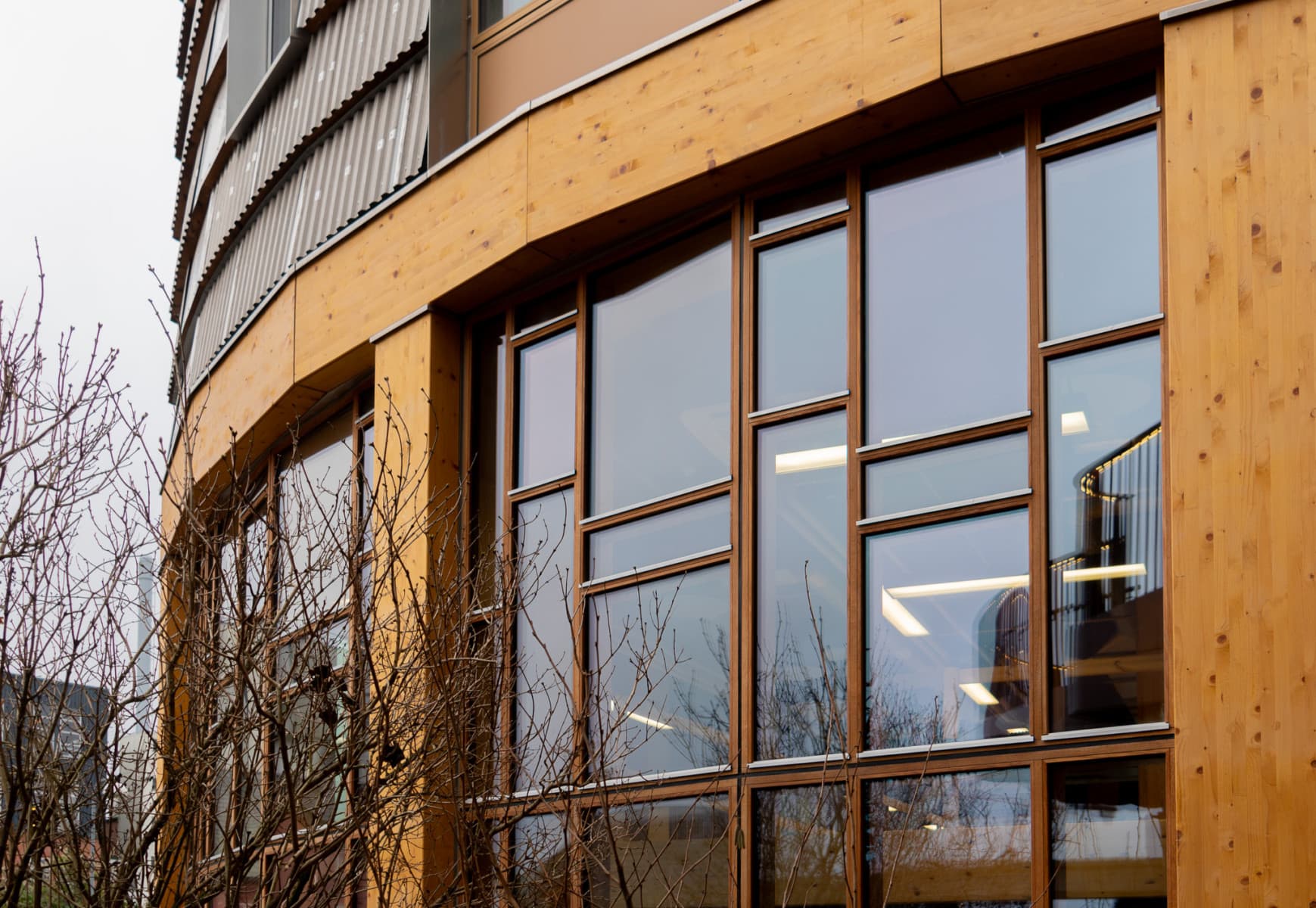
Photo credit: a:gain

A low percentage of Insulated Glass Units (IGUs) at VELUX Group factories display minor visual variations, such as minor air bubbles, that do not affect their technical performance. While these fully functional IGUs retain full technical performance, they cannot be used in roof windows, and they are therefore typically downcycled into other glass products such as bottles and drinking glasses.
As part of VELUX Group’s circularity ambitions and to test the potential for upcycling these glass units, VELUX and its sister-company DOVISTA are working with circular product provider a:gain. Both VELUX and DOVISTA are part of the VKR Group.
The collaboration between a:gain, VELUX and Krone Vinduer, one of DOVISTA’s three Danish facade window brands, focuses on upcycling materials to a next life in Viddø, a facade window system developed by a:gain. The window system is characterised by a lower number of material processes, minimal waste, and a significantly lower carbon footprint than comparable window systems.
We are mapping circularity potential across our entire value chain to make optimal use of our resources and materials, through a number of activities including various experiments in pilot projects. Glass production is CO2 and resource intensive and we seek to avoid downcycling whenever we can. Viddø is an example of a product that promotes circularity in a very tangible and scalable way – says Lone Feifer, Director for Sustainable Buildings at the VELUX Group
In this collaboration, VELUX Group will supply IGUs from its factories to one of DOVISTA’s Danish brands, Krone Vinduer, that handles the production and mounting, while a:gain is solely responsible for product design, documentation, marketing, and sales under its own Viddø brand.
Viddø has a third-party verified Environmental Product Declaration (EPD) used in calculating a building’s carbon footprint. While the exact carbon savings from using these IGUs in facade windows depend on the specific project conditions and assessment methodology, calculations from an avoided emission study show potentially up to a 44% lower carbon footprint than comparable facade window systems[1]. Thanks to a:gain’s digital design tool, it is easy for architects to draw and specify Viddø into their projects.
At a:gain we make fully documented building products from materials such as IGUs and other recyclable resources at scale. Industry leaders like VELUX Group and DOVISTA are key to this mission. Their production expertise combined with our knowledge of circular product development is what makes collaborations like this possible – and what will move the construction industry toward a more circular future, – says Thomas Heldgaard, CEO at a:gain
Viddø has already been delivered to several projects such as TRÆ in Aarhus by Lendager Architects, Nest House by EFFEKT Architects, and Skovhuset, designed by Kasper Guldager, Lasse Lind and Emilie Lind Fenhann. The Viddø facade solution is also installed at CPH Village Østerbro, to be completed in the coming months. In addition, Viddø has readily been specified for upcoming large-scale projects.
We’re constantly seeking to decarbonise by working with industry specialists on solutions that help us scale circular construction approaches, – says Frank Radich, CTO & Senior Vice President at DOVISTA Group, a European leader in vertical windows and exterior doors.