Skip to content

News

Urban planning and development

Buildings

District energy

+2

Copenhagen named the most liveable city in the world

For the second year in a row, Copenhagen tops the Global Liveability Index, confirming the Danish capital's position as a global benchmark for stable, well-run and sustainable urban living.

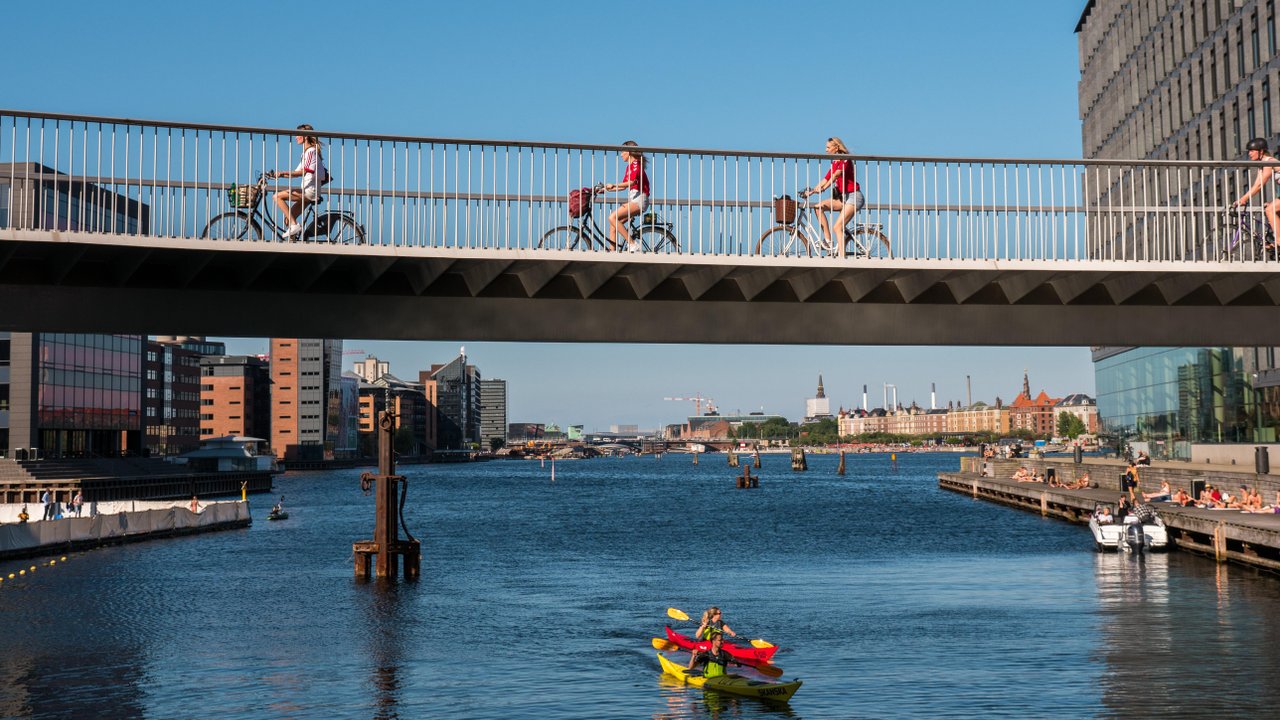
Copenhagen bikes on bike path over the harbour. Photo credit: Visit Denmark / Daniel Rasmussen

Copenhagen has retained its position as the world’s most liveable city in the 2026 Global Liveability Index from the Economist Intelligence Unit (EIU), scoring 98 out of 100 overall. This marks the second year in a row, which the Danish Capital has led the ranking of 173 cities worldwide.

The index, now in its long-running annual edition, assesses cities across five categories: stability, healthcare, culture and environment, education, and infrastructure. Copenhagen scored a perfect 100 in three of these categories, including infrastructure, and above 95 in the remaining two.

Copenhagen vs Western Europe vs the global average

Category scores out of 100. Click a legend item to hide or show a series, or hover a bar for a closer look.


Copenhagen


Western Europe average


Global average

100

86

73

Stability

96

95

78

Healthcare

95

92

74

Culture & environment

100

96

85

Education

100

93

76

Infrastructure

Source: EIU Global Liveability Index 2026.

Infrastructure as a foundation for liveability

Infrastructure carries a fifth of the total score in the EIU’s methodology, covering factors such as the quality of public transport, energy and water provision, road networks and telecommunications. Copenhagen’s perfect score in this category places it, together with Vienna, at the top of all 173 cities assessed.

The result reflects decades of sustained investment in public infrastructure, district energy and mobility systems in the Danish capital, areas that have long been central to Denmark’s approach to urban planning and its wider green transition.

A steady performer as global stability declines

The 2026 index shows the average liveability score across all cities holding at 76.1 out of 100, unchanged from the previous year. Behind that stable headline figure, however, average stability scores fell by 0.5 points globally, driven in large part by the war in Iran and its impact on cities across the Middle East and North Africa.

Copenhagen and the rest of the top ten cities were largely unaffected by this trend, recording no year-on-year change to their already near-perfect scores. Western Europe remains the most liveable region overall, with an average score of 91.7, ahead of North America on 90.4, although the EIU notes that the region’s average has stagnated this year while Asia’s has continued to climb.

The top 10 most liveable cities

Overall score out of 100, ranked out of 173 cities

1
CopenhagenDenmark

98

2
ViennaAustria

97

3
MelbourneAustralia

97

4
SydneyAustralia

97

5
ZurichSwitzerland

96

6
GenevaSwitzerland

96

7
OsakaJapan

96

8
AdelaideAustralia

96

9
VancouverCanada

96

10
TokyoJapan

96

Show all 10 cities

Source: EIU Global Liveability Index 2026.

A ranking with real-world weight

The EIU’s Global Liveability Index is widely used by governments, investors and multinational organisations to benchmark cities for purposes ranging from investment decisions to expatriate relocation packages. For international stakeholders assessing where to locate operations, talent or partnerships, the ranking offers an independent, data-driven signal of a city’s stability, quality of life and functioning infrastructure.

Copenhagen’s repeated top ranking places it alongside a small group of cities, including Vienna, Zurich, Geneva, Melbourne and Tokyo, that combine strong public infrastructure with high scores across healthcare, education and culture and environment.

The Global Liveability Index

The Global Liveability Index by the Economist Intelligence Unit compares 173 cities on the everyday conditions that make places work well for people. Covering stability, healthcare, culture and environment, education, and infrastructure, the index offers a global benchmark for liveable cities and the foundations that support healthier, more resilient urban communities.

Discover the 2026 Global Liveabiliy Index


You should consider reading

Buildings
District energy
Urban infrastructure planning
Urban mobility
Urban planning and development

Solution

Building design

+20

Renewables Focus with Port Development

2 April 2026
A European municipality sought to define a clear vision for transforming an industrial area into a hub for renewable energy manufacturing, while aligning stakeholders including municipal staff and elected officials.