Skip to content

Perspective

Non-revenue water

Policy frameworks

Water management

The importance of public awareness and political targets

Awareness of water’s true value varies greatly, often leading to underpriced water that fails to cover actual costs. By combining regulation, economic incentives, public awareness and transparent benchmarking, it is possible to reduce consumption and losses. These measures help ensure reliable, efficient water systems.

The awareness and understanding of the value of water varies from country to country. Often, the price of water does not cover the actual investment and operational costs necessary to treat and deliver clean drinking water.

Political focus and priority from government institutions are necessary to make consumers aware of the value of having a stable supply of clean water.

In many places, the apparent losses pose the biggest challenge and require a change in consumers’ mindsets to bring them down. NGOs and anthropologists can be involved in changing people’s mindset and behaviour when it comes to drinking water, as well as their understanding of how consumer payment for water is necessary to ensure sufficient funding for the development of a sustainable water supply with clean and safe water.

Public awareness and economic incentives to reduce NRW

Denmark has shown that economic growth and decreasing resource consumption are not mutually exclusive; they can, in fact, go hand in hand successfully.

Over the past 30 years, Denmark’s GDP has increased by 75 percent while the water consumption has decreased by 40 percent. The Danish approach, consisting of continuous public awareness concerning the importance of saving water together with economic incentives, has resulted in water consumption figures that are acknowledged worldwide.

Politicians and decision makers in Denmark have understood that public regulation and taxes are important and effective tools for behavioural change. In 1996, a general requirement was introduced for the installation of water meters at the consumer level in Denmark, giving private households access to their water consumption data. Furthermore, Danish authorities impose an annual penalty on water utilities that do not maintain their NRW level below 10 percent through extra taxes on lost water.

In 2024, the total price for water supply and wastewater treatment was an average of EUR 11.01 per cubic metre. The same year, water consumption in Denmark per capita was on average 97 litres/day, showcasing that the price of water can serve as a strong incentive for the public to reduce consumption.

The national average for NRW has been reduced to 7.5 percent due to the long-term intervention. Moreover, government regulations have motivated water utilities and technology providers to develop new, cost-efficient leakage monitoring technologies and leakage management systems. The highly efficient Danish water distribution system can also be reflected in the fact that the average ILI has remained below 1.0 for many years.

Water consumption in Denmark, 1976-2024

Denmark has steadily reduced total water consumption per capita from 1976 to 2024—across households, industry and institutions—while keeping water losses (NRW) low, reflecting the impact of long-term regulation, efficiency measures and sector reform.

Water consumption in Denmark in figures - 1976-2024 Danva
forside Danva Water in Figrues 2025 report

Discover Denmark's water supply in numbers

Download the latest report from DANVA here: www.danva.dk/waterinfigures

Get the report

Benchmarking for efficiency and constructive competition

Benchmarking serves as a valuable tool for water utilities to assess performance and enhance operational processes. The Danish Water and Wastewater Association (DANVA) annually collects and publishes performance data from participating utilities. This systematic approach fosters transparency and continuous improvement across the sector.

As of the latest available data, 78 drinking water companies and 91 wastewater companies participated in DANVA’s benchmarking program, contributing data for the year 2024. These companies serve approximately 60 percent of the Danish population with drinking water and treat wastewater for about 90 percent of the population.

The benchmarking process enables utilities to compare KPIs, identify areas for improvement, and implement strategies to reduce water loss and enhance efficiency. Denmark’s benchmarking framework introduces a dimension of transparency and perhaps even constructive competition.

Utilities are not only encouraged to improve their own operations but are also motivated by peer comparison to adopt new technologies and optimise performance.

Public visibility of benchmarking outcomes reinforces a culture of accountability and innovation, helping to drive sector-wide efficiency improvements.

Download the latest report from DANVA here: www.danva.dk/waterinfigures

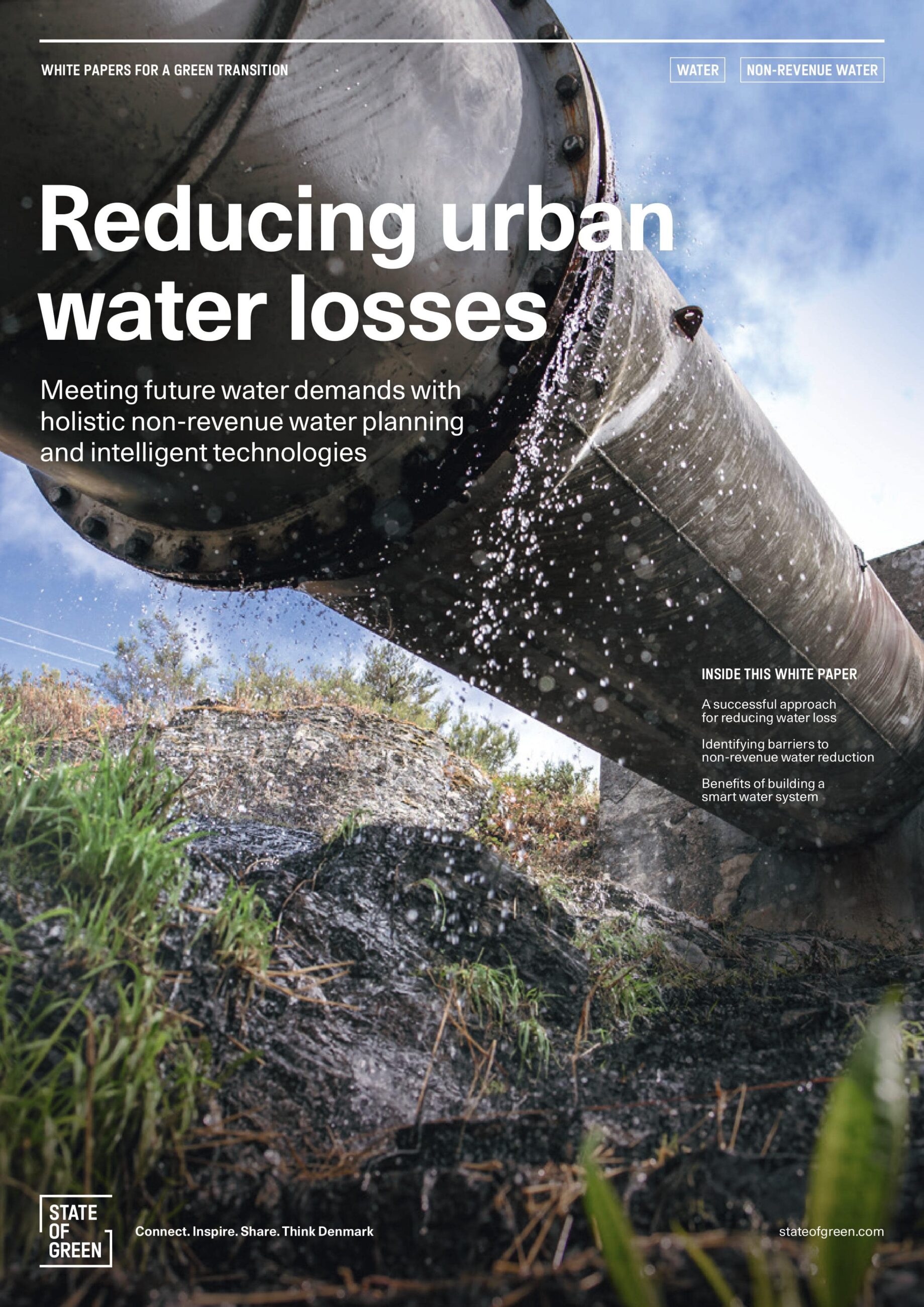
front page white paper reducing urban water losses

Discover our publication on reducing urban water loss today

This article is part of our publication ‘Reducing urban water loss’. Packed with insights and cases from Danish water experts, the publication outlines how holistic planning, innovative technologies and integrated management can reduce urban water losses and build secure, resilient water systems for the future.

Explore the publication

You should consider reading

Non-revenue water
Policy frameworks
Water management

Event

Water supply

+19

Danish Water Export Day 2026

3 June 2026
Water Export Day is being held this year on September 1st at Danish Industry, bringing together the Danish water industry with a focus on exports. Together, we will discuss how and what opportunities exist to strengthen the export of Danish water technology and know-how. The event will serve as a pl