Perspective by
Mikael Kamp Sørensen Executive Vice President, Energy & Water Resources at DHI
Perspective
Wind energy
Offshore wind
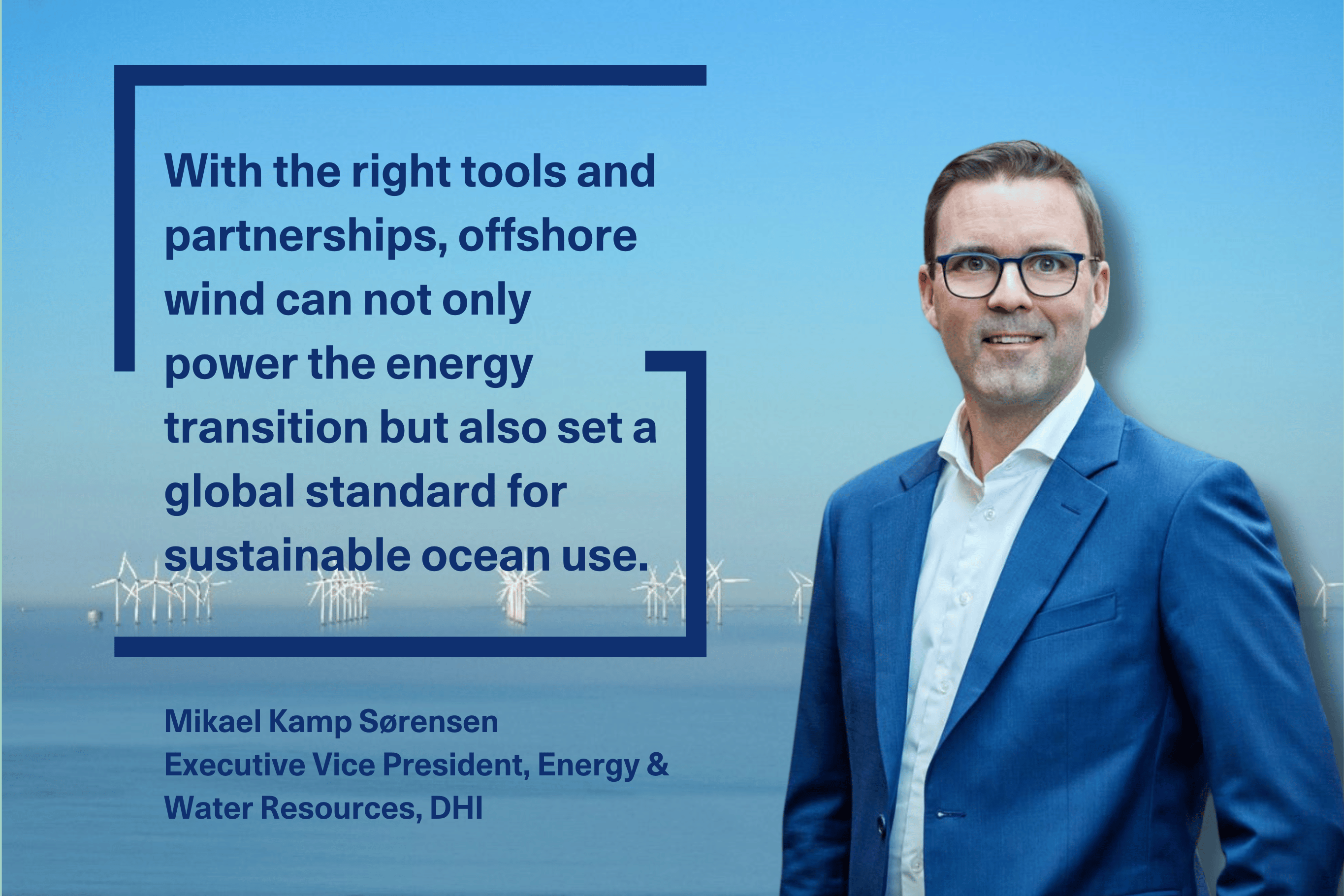


Mikael Kamp Sørensen Executive Vice President, Energy & Water Resources at DHI
The EU aims to reach 300 GW of offshore wind by 2050, but achieving this scale poses significant challenges. Developers must contend with increasingly complex sites, sensitive marine ecosystems and tight permitting timelines. Ocean conditions — such as waves, currents and sediment transport — can significantly impact turbine design, cable routing and overall project risk. At the same time, environmental pressures demand that offshore wind expansion does not come at the cost of biodiversity. The industry urgently needs tools and knowledge to ensure projects are not only viable, but sustainable in the long term.
‘Offshore wind can only scale successfully if we truly understand the ocean systems we are building in,’ says Mikael Kamp Sørensen. ‘An important part of the solution is digital tools and high-resolution modelling that enable informed decision-making from early site screening to post-construction monitoring.’
Solutions such as digital twins, real-time metocean forecasting and marine ecological modelling can support developers in eliminating risks. These tools help reduce uncertainties, accelerate permitting and improve both environmental and economic performance. In France and across Europe, DHI is contributing to projects that align offshore wind development with marine spatial planning and nature protection goals.
DHI is a global leader in water and environmental solutions, leveraging digital innovation, expert consultancy, and advanced modeling to address complex challenges in marine, freshwater, and urban water systems.
ViewOne of the major bottlenecks in offshore wind is data availability and integration. Many projects still rely on fragmented datasets or outdated methods, which can delay permitting and increase costs. Moreover, cross-sector collaboration between energy developers, marine scientists and regulators is often lacking. Technical capacity, regulatory frameworks and financing mechanisms must evolve in parallel to support the deployment of digital ocean intelligence at scale.
To accelerate offshore wind deployment while protecting marine ecosystems, Europe must invest in digital ocean infrastructure and foster stronger collaboration between science and industry.
To accelerate offshore wind deployment while protecting marine ecosystems, Europe must invest in digital ocean infrastructure and foster stronger collaboration between science and industry. ‘We need to treat ocean data as critical infrastructure — just like grids or ports,’ says Mikael Kamp Sørensen. ‘With the right tools and partnerships, offshore wind can not only power the energy transition but also set a global standard for sustainable ocean use.’

DHI is part of the royal visit to France 2025. Connect with future business partners and get inspired by French-Danish collaboration driving solutions towards a net-zero society.
Discover the royal visit to France