This following is foreword for the publication “Towards a sustainable industry” – white paper presenting solutions for competitive, efficient and resilient production.
Perspective
Efficient food production
District energy
Energy efficiency in industry
+1
Empowering a green and competitive Danish industry
Ambitious climate action and industrial competitiveness can go hand in hand. Read the foreword for the publication "Towards a sustainable industry" by Lars Aagaard, Denmark’s Minister for Climate, Energy and Utilities and Magnus Heunicke, Minister for Environment and Gender Equality.

17 July 2025
Foreword by


Lars Aagaard
Minister for Climate, Energy and Utilities of Denmark


Magnus Heunicke
Minister for Environment and Gender Equality
Strong industries are vital for prosperity and resilience. But industry also contributes significantly to global emissions and resource use. Denmark aims to be among the world’s first climate-neutral countries by 2045 and climate negative thereafter. Through ambitious regulation and strong partnerships across public and private sectors, Denmark has created a framework that drives both climate action and industrial competitiveness.
Energy efficiency is a Danish tradition. Since the oil crisis in the 1970s, we have worked to reduce energy consumption, resulting in one of the world’s least energy-intensive industries. Danish companies provide pioneering solutions for optimising production, electrifying processes, integrating renewables and recovering excess heat.
With volatile energy prices and pressured supply chains, energy efficiency offers a clear business advantage. Through initiatives like energy efficiency obligations, incentive schemes, sector coupling, sector-specific climate partnerships and targeted green R&D funding, we enable Danish companies to reduce energy use while boosting productivity. Since 1990, the Danish economy has grown by 80 percent, while energy consumption has dropped by 17 percent and GHG emissions by 46 percent (2023).
Internationally, Denmark also promotes higher energy efficiency standards—from advancing EU regulations like the Eco Design Directive to driving bilateral government-to-government cooperation on regulatory frameworks. We support global industrial decarbonisation by sharing experience in energy and CO₂ audits, standardisation, industrial symbioses and more. Denmark’s green transition of industry is also promoted through CO₂ pricing, coupled with the possibility of transition support, which contributes to financing investments in, for example, electrification, hydrogen and CCS.
The Danish approach to industrial growth ensures environmental protection and resource efficiency go hand in hand. We pursue a “Water Efficiency First” principle—using no more water than necessary for industrial processes. Ambitious regulation and permitting push industries to reduce emissions and improve water resource efficiency. Innovation is supported by long-term policy and collaboration across companies, utilities and technology providers.
To support the industrial green transition and sustainable resource use, the Danish government has introduced new legislation on “technical water,” enabling industries to use, for example, treated wastewater or contaminated groundwater in their processes.
Danish companies are reusing water in closed-loop systems, lowering energy use in wastewater treatment and transforming waste into new resources. The result: industries that view water and waste not as challenges, but as valuable inputs.
By managing and valuing resources efficiently, Danish industries demonstrate that green solutions are good for both the planet and business. A circular economy will also strengthen the strategic autonomy of Denmark and the EU, as reduced material consumption and increased recycling can enhance supply security for Danish businesses and reduce dependence on imported raw materials.
This white paper presents the public and private efforts driving Denmark’s competitive green transition, and we hope it inspires new action.
Discover the publication
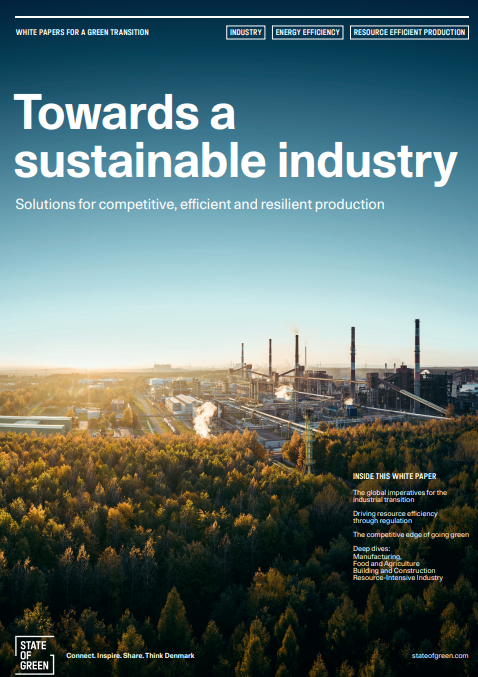
This article is a part of the publication “Towards a sustainable industry”. Featuring in-depth cases and insights from key Danish players, the white paper offers a toolbox of ideas, technologies, and frameworks for a green transition.
Explore the white paperYou should consider reading
District energy
Efficient food production
Energy efficiency in industry
Environment and agriculture

Solution
Bio-based circular solutions
+8
Biogas turns waste into value
20 August 2026Decarbonising energy systems requires solutions tailored to local conditions. While electrification is the preferred option for many applications, sectors such as high-temperature industrial processes still require renewable gaseous fuels. At the same time, agriculture produces large volumes of manu