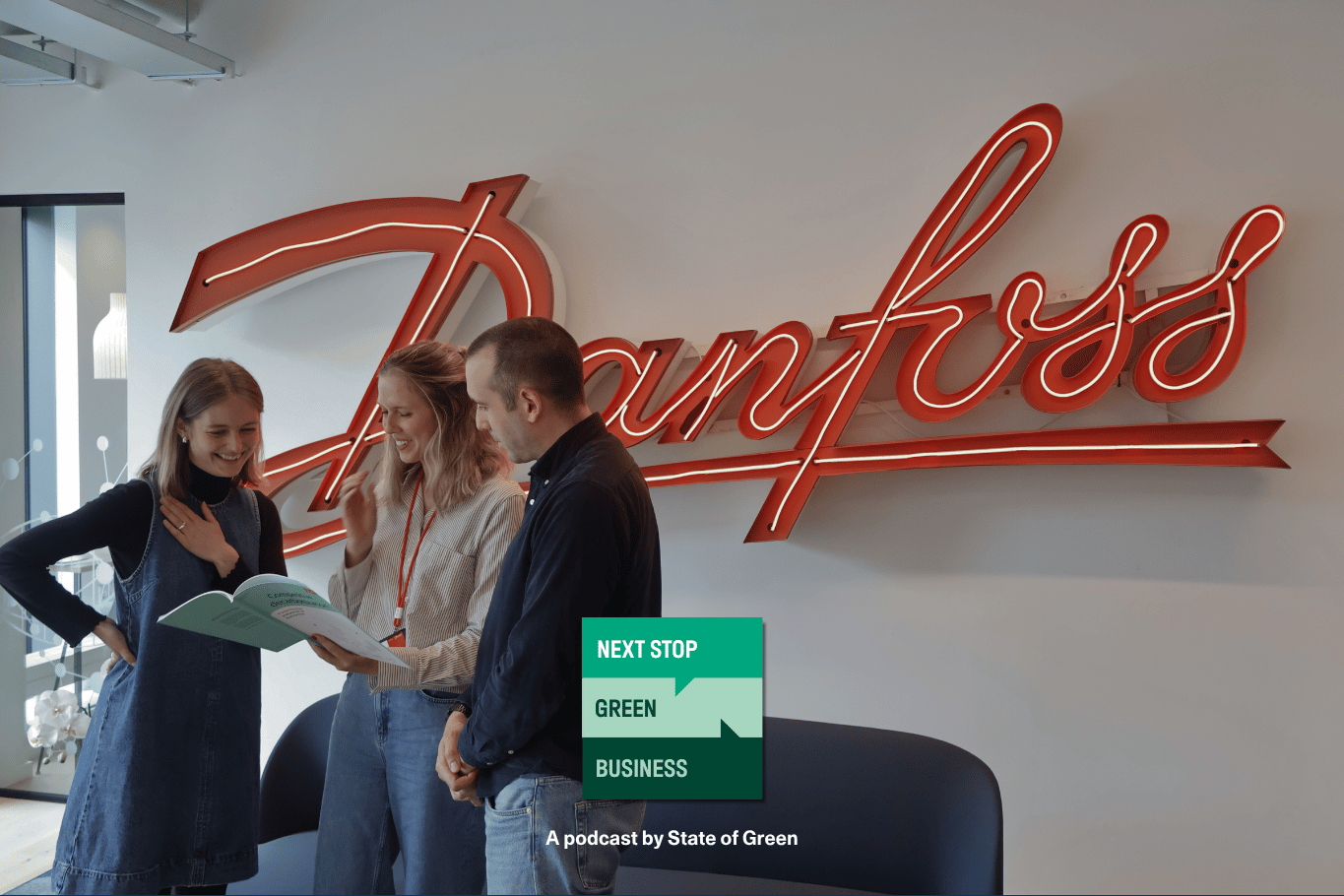
Taking your own medicine often carries an unpleasant connotation. For Danfoss, however, it’s a proof of concept: By applying their own technologies to cut emissions, they demonstrate how competitive decarbonisation works in practice — both for the bottom line and for the climate. Learn more in this podcast episode of 'Next Stop: Green business'.
In this episode of “Next stop: Green business”, we visit Danfoss. Many of us know Danfoss for their thermostats, but actually, they only account for 0.04 % of the business.
What Danfoss essentially does is provide components for industry and buildingsthat increase machine productivity, reduce emissions, lower energy consumption, and enable electrification.And with over 100.000 unique product references, taking their own medicine isno small feat.
Listen to the episode in its entirety:
Next stop: Green business
In this podcast series, we ask Danish companies why they continue to believe, despite growing pressures and uncertainties, that green business is good business. The series will be published bi-weekly on your favourite podcast streaming platform.
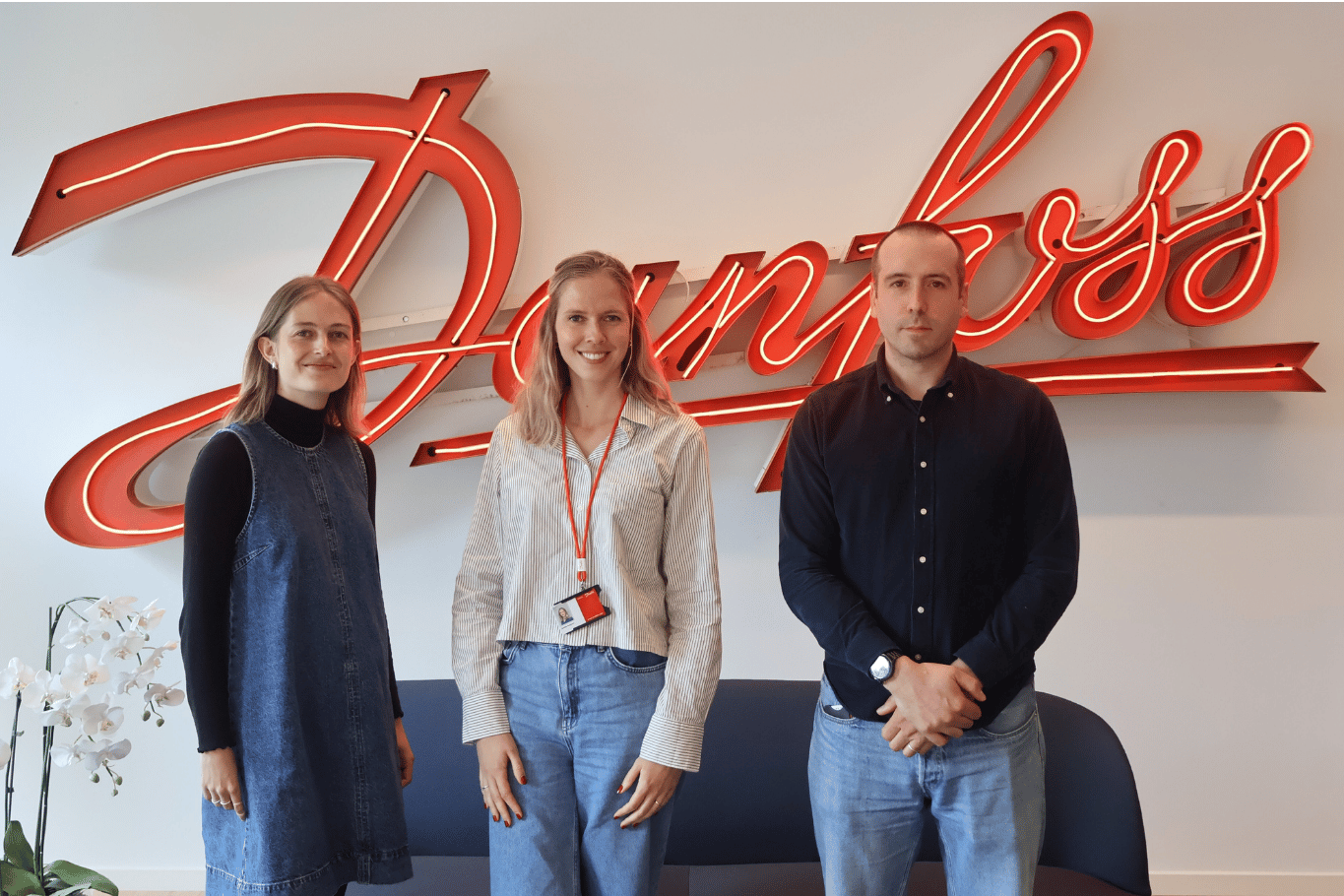
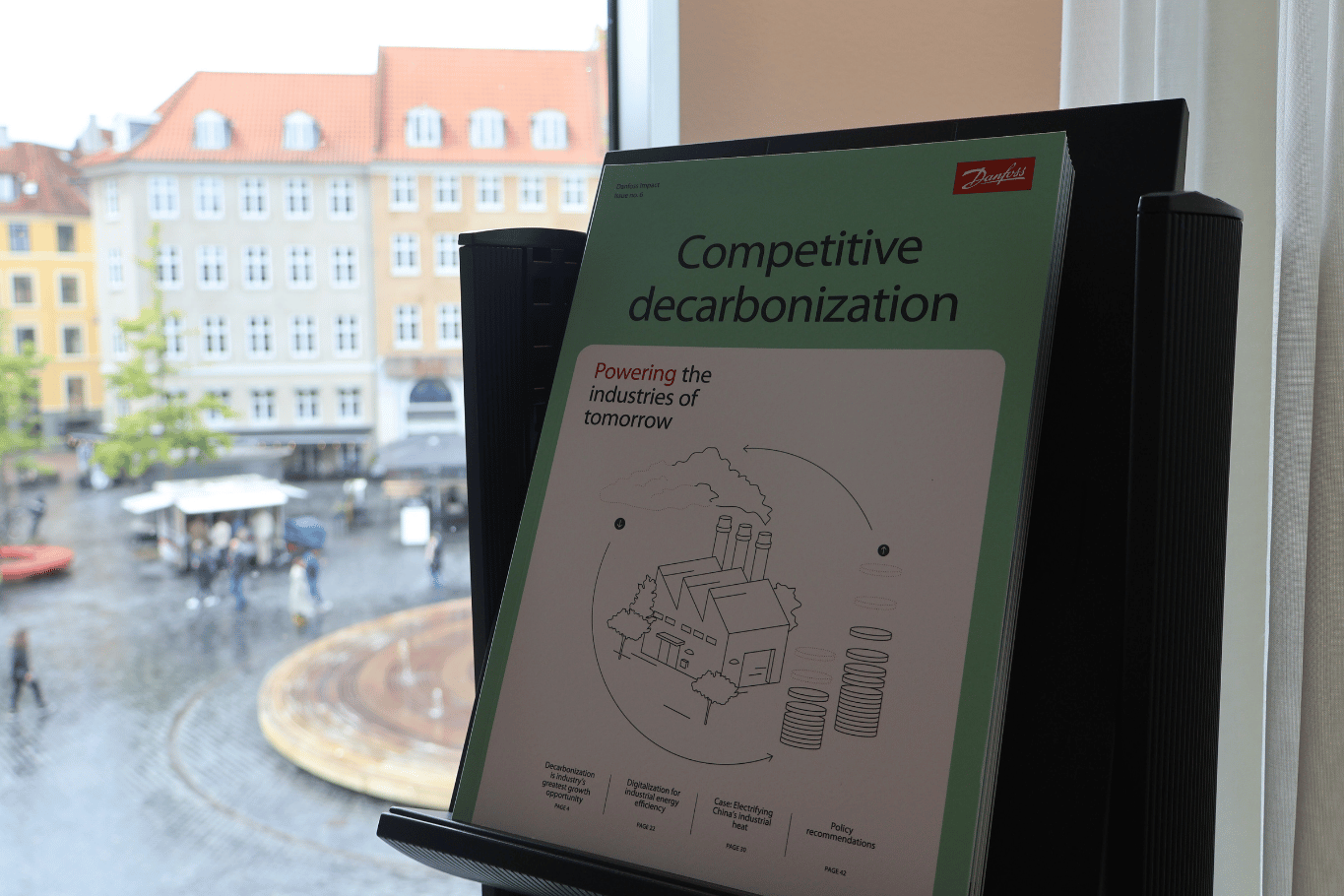
We visited Danfoss at their offices at Kultorvet in central Copenhagen. Here, Judith Neijzen, Head of the Analysis Team in Corporate Public Affairs and Victor Gancel, Climate and Decarbonisation Lead within group sustainability, explained what sustainable self-medication looks like in practice. And in terms of decarbonising their production, it can be put into three simple steps.
Generally, we like to think of three practical steps. The first is energy efficiency, right?
The second step is electrification. Electrification, in itself, is also an energy efficiency measure, and of course, that is where we need to go.
And then, the third step is thinking about these initiatives as part of a system and integrating them. We can look at one machine, but what if we could take the excess heat from that machine and use it to heat the spaces we work in, or even connect it to the district heating system?
Judith Neijzen, Head of the Analysis Team, Corporate Public Affairs
The flagship example of this approach is the Danfoss headquarters in Nordborg (Climate Solutions Application Development Center) in southern Denmark. Here, they have cut heating needs by 79% and reduced energy consumption by 50%, and the factory they have on site has been certified CO2-neutral. The doors are very much open for people to come and see these achievements, because the true success of these efforts lies in inspiring others.
So I think it’s very powerful to see that a site the size of a headquarters of such a large organizationcan achieve that level of decarbonization and energy efficiency so that’s really our flagship success.
Victor Gancel, Climate and Decarbonisation Lead, Group Sustainability
The effect it has—and what we see again and again—is what we like to call ‘seeing is believing.’ A big barrier, I think, for end users and consumers is simply the notion that it’s not so scary. It’s possible. Others have done it. It’s not complex. Maybe I should also do it, or perhaps I just didn’t know this was possible. I think that, in itself, is almost a more surprising success.
Judith Neijzen, Head of the Analysis Team, Corporate Public Affairs
Resilience, competitiveness, and energy efficiency go hand in hand
For Danfoss, seeing is believing and also about showing that competitive decarbonisationis a scalable business model. From a country like Denmark, where the energy infrastructure lends itself well to these types of projects, to a place like Poland, where the energy mix is still dominated by fossil fuels, Danfoss has shown that investments in energy efficiency and decarbonisation are worth it.
Yes, in Nordborg, the payback time was three years. Of course, Nordborg is in Denmark, and things might be easier there than in other parts of the world. However, if we look at our factory in Grodzisk, Poland, the payback time there was two and a half years. If it can be done there, then it can be done in many other places too.
Judith Neijzen, Head of the Analysis Team, Corporate Public Affairs
The value of making these investments is especially significant in a world where energy efficiency is tied to security, as Danfosscan attest to.
Competitive decarbonisation is very much a resilience strategy. For example, we were resilient during the energy crisis because we had implemented these solutions. We weren’t hit as hard because we weren’t as dependent on external energy sources. This concept can even be scaled up to a regional or national level—if you’re less reliant on energy imports, you become more resilient. Your own production site could almost become a circular system that feeds itself.
Judith Neijzen, Head of the Analysis Team, Corporate Public Affairs
As Judith and Victor repeatedly stress during our interview, this (competitive decarbonization) isn’t a side project for Danfoss — it’s a directive from leadership. It’s critical to deliver on the green agenda to protect our collective future, and at the same time, it’s meaningful because it’s tied to long-term prosperity for the business.
When you invest in increasing factory productivity and energy efficiency, you can actually save money. For example, we were paying less for energy than some of our competitors.
Victor Gancel, Climate and Decarbonisation Lead, Group Sustainability
It’s not just a nice-to-have for the climate; it’s a must-have for the business. And we will not be in business if we don’t take this very seriously. I know our CEO likes to say, ‘We don’t want to be the greenest business out of business.’
Judith Neijzen, Head of the Analysis Team, Corporate Public Affairs
Danfoss
Danfoss engineers solutions that increase machine productivity, reduce emissions, lower energy consumption, and enable electrification.
Like many other companies, Danfoss’s sustainability efforts are guided by science-based targets. But despite the many operational changes, they mustsee through, it’sactually the internal organisational transformations they highlight when I ask their biggest hurdles – or toughest pills to swallow:
I think it’s important to keep in mind that a science-based target is a transformative one. It’s not an easy target; it is, by definition, a stretched target for companies.
It’s not enough to be manufacturing sustainable products to achieve your science-based target. You need to transform the organisation. To become a sustainability leader, you really to to modify the organization compared to what it was in the world before.
Victor Gancel, Climate and Decarbonisation Lead, Group Sustainability
An equally important, and perhaps slightly surprising aspect of sustainability leadership is being loud and proud about successes. As Victor argues, hiding progress can be just as risky as exaggerating it. Theclimate crisis can’t be solved in silence.
If companies want to lead, they have to share. There’s greenwashing, but there’s also green hushing. What we’re seeing is that companies are starting to feel uncomfortable about sharing their successes because they fear criticism or excessive scrutiny. I think this is a concerning trend. We don’t have the luxury of time to win the climate battle, and we cannot allow every organization—from the big ones to the SMEs—to figure things out alone in silos.
Victor Gancel, Climate and Decarbonisation Lead, Group Sustainability
Ultimately, what Danfoss hopes to convey and feels a responsibility to convey is that the green transition of industrydoesn’t have to wait for the next big breakthrough. Progress isn’tmade by grandstanding, but by showcasing known, energy-efficient, and green solutions in action.
The key point here, which we often emphasize, is that most of what you need is already available. The solutions already exist. So this is not about fancy new innovations.
People are convinced when they realise that the solutions are already out there. It’s no longer about being the first to commit to something or having the biggest or most extensive projects. It’s about implementing what’s available as quickly as possible to even come close to ‘making it.’
Judith Neijzen, Head of the Analysis Team, Corporate Public Affairs
In other words, the cure is already here – and it’sboth green and competitive.
It’s simply a sound business case. And I think that’s going to be key now that companies and governments have made their climate commitments. Now, it’s about actually taking action. That’s the challenging and, frankly, intimidating part. That’s why we’re discussing this now in this way. We’re not saying anything different from what we’ve said before; we’re just emphasizing that this is sensible business. In fact, if you don’t act, it will harm your business.
Judith Neijzen, Head of the Analysis Team, Corporate Public Affairs
The competitive advantage of green supply chains
Discover tangible cases and connect with solution providers that have turned green supply chains into a business advantage.