Skip to content

Perspective

Energy efficiency in industry

Circular business models

Circular economy

+5

Driving resource efficiency with regulation

Resource efficiency is an essential part of any governmental strategy to guarantee sustainable economic growth. Denmark displays policies and instruments that can enhance security of supply, boost competitiveness and welfare, and reduce the environmental footprint of industries globally.

Different instruments, one shared goal

Nearly 50 years of Danish resource efficiency policies show that economic growth can be decoupled from resource use.   

Denmark’s approach includes three types of instruments: 

  1. Normative – regulations like “Obligatory Energy and CO₂-reduction Audits for Large Energy Users” 
  2. Informative – tools and guidance such as SparEnergi.dk 
  3. Economic – CO₂ taxes, subsidies and schemes like the Business Pool and the Voluntary Agreement for Excess Heat 

A key lesson learned from Danish experiences is that a multipronged effort using several instruments aligned toward the same goal has the greatest effect on resource use. 

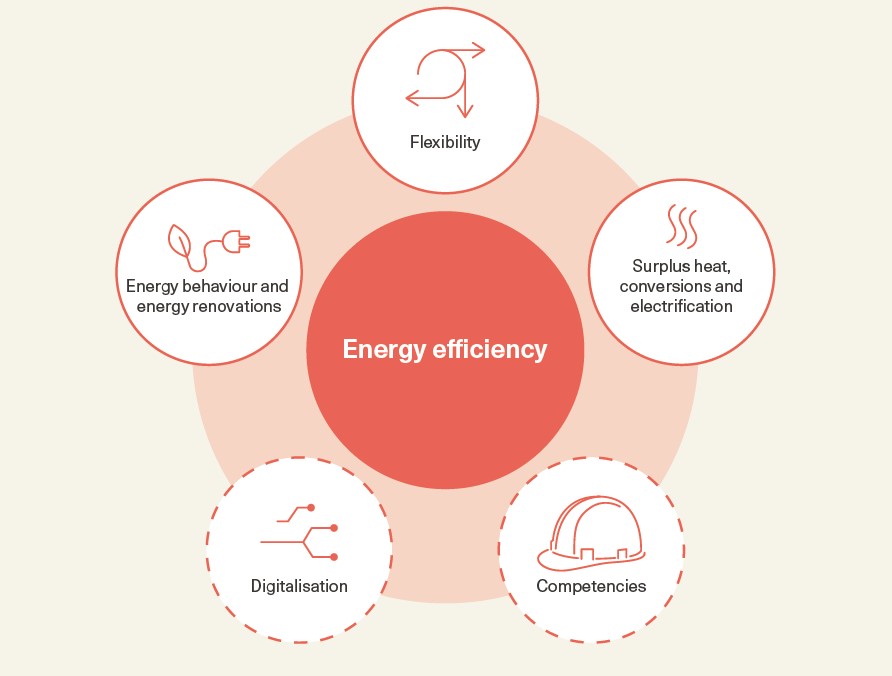
The Danish Energy Efficiency Roadmap

The Danish approach to energy efficiency includes reductions in energy consumption (e.g. energy behaviour and energy renovations), consuming energy when it is greenest (e.g. flexibility) and shifting industrial energy input to renewable sources (e.g. surplus heat, conversions and electrification). This is supported by digitalisation and competencies in order to get the most out of the overall energy system.

The Danish Energy Efficiency Roadmap

From energy reduction to CO₂ reduction

Initially driven by energy security, Danish energy efficiency efforts now focus on emissions reduction. Still, lower energy use matters in helping Denmark meet its 2030 target to cover all electricity and district heating needs with renewables. To target remaining CO₂ emissions from industry, policies support electrification through heat pumps, excess heat reuse and process optimisation.  

Notably, Denmark now applies CO₂ taxes to industry and agriculture and requires CO₂-reduction audits for large energy users. The latter goes beyond EU mandates by obliging businesses to map emission sources and outline action plans to reduce them.   

Circularity in practice

Denmark is committed to driving the green transition through environmental policies that support sustainable industry practices and promote the efficient use of resources. Among the key focus areas is water reuse, where Danish authorities explore opportunities to use reclaimed wastewater. In agriculture, for instance, permits can be granted when wastewater demonstrates agronomic value—either as a fertiliser or to enhance soil quality—ensuring safe and beneficial use. 

At the EU level, Denmark supports policies aligned with its goals, including the EU Regulation on water reuse, the Ecodesign for Sustainable Products Regulation, and the Critical Raw Materials Act. These aim to reduce environmental impacts across product life cycles, strengthen recycling, and secure access to critical materials. The upcoming Circular Economy Act, expected in 2026, will hopefully build on these efforts by providing a holistic approach to the circular economy, and could introduce 2030-targets for the reduction of consumption and material footprint. 

As part of its ongoing commitment, Denmark is preparing to update its national Circular Economy Action Plan. Through targeted policies and active participation in EU initiatives, Denmark seeks to foster a resilient, competitive, low-impact industrial landscape rooted in circularity. 

Publication frontpage

Discover the publication

This article is a part of the publication “Towards a sustainable industry”. Featuring in-depth cases and insights from key Danish players, the white paper offers a toolbox of ideas, technologies, and frameworks for a green transition.

Explore the white paper

You should consider reading

Circular business models
Circular economy
Digitalisation
Energy efficiency in buildings
Energy efficiency in industry
Policy frameworks
Resource efficient production
Resource reuse and recycling