1/4
Perspective
Green value chains
Circular value chains
Green supply chains
+1
The competitive imperative
Green business is good business. Beyond compliance with regulatory standards and risk mitigation, companies that invest in sustainable practices are experiencing significant cost savings, operational efficiencies, and enhanced market positioning.
16 July 2025
The imperative for pursuing a green transition of industry is not just about climate targets and resource preservation – it’s about competitiveness. More and more companies around the world are already turning their transition into a driver of value creation and the business case is clear.
Efficiency equals resilience
One of the most compelling reasons for industries to invest in green solutions is the potential for significant cost reductions. Energy efficiency, water conservation, and waste minimisation are all areas where companies can achieve substantial savings with attractive returns on investment.
In Europe, for instance The European Commission has reported that water recycling can reduce water-related costs by 50-70 percent in manufacturing sectors through better water management and technology integration. Further, it estimates that energy efficiency in the industrial sector could lead to cost savings of up to EUR 60 billion annually in Europe, driven by improved technologies and processes.
Considering the volatile energy prices of recent years coupled with concerns about security of supply, efficient energy management should also be seen as the foundation of resilient business models. The same goes when it comes to water and other scarce resources.
The energy systems of tomorrow will be highly integrated and powered by renewable electricity primarily. One of the key challenges in electrifying industry is maintaining competitiveness – particularly in the short to medium term, as electrification can be costly. However, increased flexibility and sector coupling offer promising solutions, helping to unlock efficiencies and bring down costs as part of the broader green transition.
The time to move is now
The business case for an industrial green transition is further strengthened by the increasingly green expectations put on companies from consumers, investors and regulators.
With growing demand from consumers for environmentally responsible products and services, sustainable practices can help businesses capture new market shares. Importantly, this consumer preference is not limited to individuals; investors are increasingly prioritising sustainability as a criterion in their decisions. Thus, companies that proactively address sustainability not only mitigate risks but also attract funding at more favourable terms, opening doors to new opportunities.
In 2025, a Danish study showed for the first time that there is a positive correlation between companies’ green efforts and their competitiveness. Companies reported benefits such as enhanced innovation capacity, improved ability to meet customer demands, and better access to new markets. Those furthest along in their green transition also see positive effects on revenue and exports. In other words, the sooner companies go green, the better.
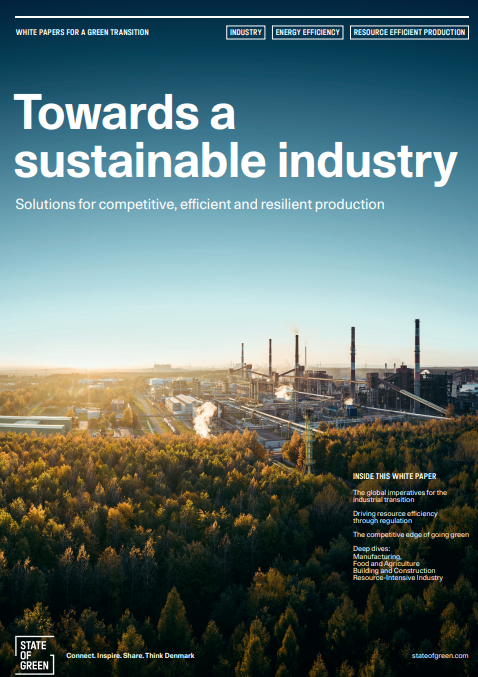
Discover the publication
This article is a part of the white paper “Towards a sustainable industry”. Featuring in-depth cases and insights from key Danish players, the white paper offers a toolbox of ideas, technologies, and frameworks for an industrial green transition.
Explore the white paperYou should consider reading
Circular value chains
Green supply chains
Green value chains
Job creation and just transition

Perspective
Job creation and just transition
+2
Denmark’s water sector has much to offer international talent - and much to gain
23 March 2026International students want to work in Denmark's water sector – and Danish companies want to hire them. A new study reveals that bridging the gap is less about motivation and more about creating clearer pathways.