Skip to content

Case

Green Shipping

Public transportation

The electric ferrytale

4 March 2026

Solution provider

ProjectZero

ProjectZero is Sønderborg’s cross-sector climate partnership, uniting citizens, businesses, utilities and the municipality to achieve a CO₂-neutral energy system by 2029 - and to serve as a living blueprint for cities around the world.

More from ProjectZero

Want to see this solution first hand?

Add the case to your visit request and let us know that you are interested in visiting Denmark

Challenge

Island and coastal communities depend on ferries for daily transport of people, goods, and vehicles. Traditionally, ferries run on diesel, making them significant emitters of CO₂, air pollution, and noise.

In Sønderborg Municipality, three ferry routes connect the island of Als with Ærø, Funen, and Jutland. Maintaining reliable maritime connections while reducing emissions posed a major challenge. The task was to decarbonize ferry operations without compromising range, capacity, or operational stability – and to prove that electric ferries could function on demanding regional routes, not just short urban crossings.

With more than 15,000 ferries worldwide carrying over 4 billion passengers annually – and only a small fraction electrified – scalable zero-emission solutions are urgently needed.

:

Video of the case

Watch Erik Lauritzen, The Mayor of Sønderborg Municipality, talk about the green transformation at sea.

Solution

Sønderborg replaced diesel ferries with fully electric vessels powered by certified renewable electricity from wind, hydro, and solar energy.

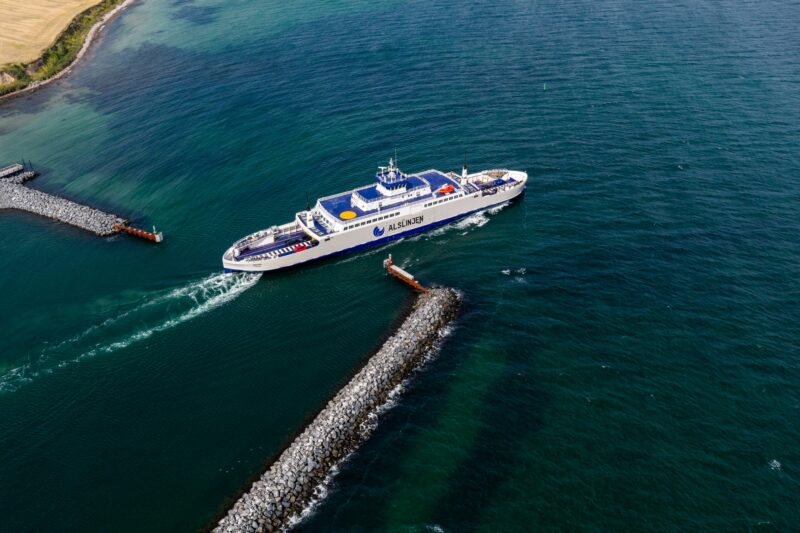
In 2019, Ellen became the world’s first fully electric ferry operating on a long regional route, connecting Als and Ærø. With a world-record range of 92 kilometers on a single charge, Ellen demonstrated that battery-electric ferries could match real-world operational demands.

In 2025, Nerthus was introduced on the route between Als and Funen. Representing a new generation of electric ferries, Nerthus features lighter and more energy-dense batteries, rapid charging in just 20 minutes during boarding, and advanced semi-autonomous docking and charging systems.

Beyond operation at sea, the solution also integrates circular thinking. When ferry batteries reach around 70 % capacity, they are replaced and repurposed on land. At the University of Southern Denmark, researchers are exploring second-life applications, using retired ferry batteries as large-scale stationary storage units to support the electricity grid
Result

The two electric ferries reduce CO₂ emissions by approximately 6,000 tons annually compared to the diesel ferries they replaced (2,500 tons from Ellen and 3,500 tons from Nerthus). They operate with zero direct emissions and eliminate both air pollution and underwater noise, benefiting passengers as well as marine life.

The project proves that large-scale, long-range electric ferries are technically feasible, economically viable, and operationally stable. In just six years, significant advancements in battery density, charging speed, power electronics, and automation have increased efficiency and scalability.

Sønderborg’s transition from Ellen to Nerthus shows how rapidly maritime electrification is evolving — and how ferry routes can become active contributors to a renewable energy system through battery reuse and grid integration.

As a scalable solution for island regions and coastal communities worldwide, the electric ferries of Sønderborg provide a concrete blueprint for decarbonizing maritime transport.

The captain of Nerthus

While the captain remains in control, digital systems optimize navigation and operational efficiency.