Smart and holistic water management
In response, industries are increasingly exploring circular and integrated water solutions to ensure both resilience and resource efficiency. A 2024 report by Danish companies Grundfos and Rambøll shows that, within light industries such as pulp and paper and pharmaceuticals, circular water strategies—ranging from internal reuse to external recycling—have a savings potential of 50–75 percent.
Alternative water sources, including treated municipal wastewater, also offer promising opportunities to replace high-quality drinking water in industrial processes and power-to-X plants, where such quality is unnecessary.
The drive for smarter water use must be approached holistically. Water and energy are deeply interconnected: water is essential for energy production, such as cooling and storage, while energy is required to pump, treat and transport water. According to the IEA, energy production alone accounts for around 10 percent of global freshwater use. Addressing water in isolation risks unintended inefficiencies or trade-offs elsewhere in the system.
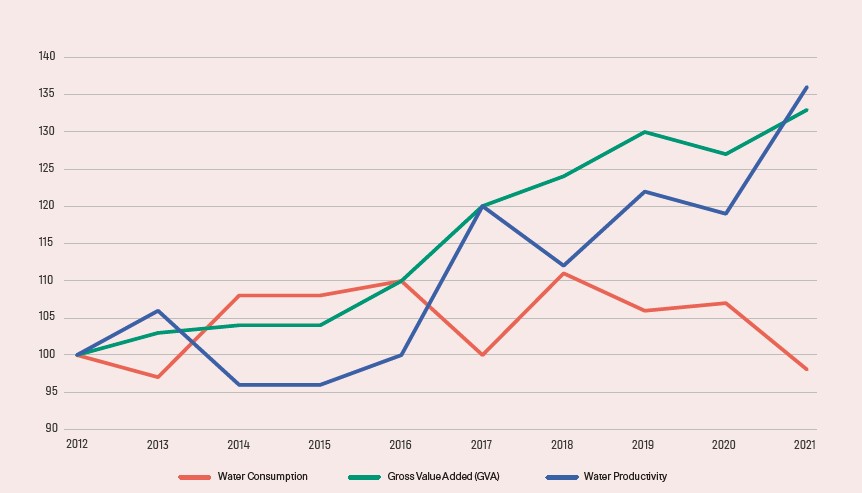
Denmark offers a stronghold in addressing these dual challenges. Through a combination of technology, regulation and collaboration, Danish industry improved its water productivity by 36 percent between 2012 and 2021. This progress reflects an integrated approach that links water reuse, process optimisation and energy efficiency. In total, Denmark has reduced its water consumption by 41 percent since 1990 while simultaneously experiencing economic prosperity.