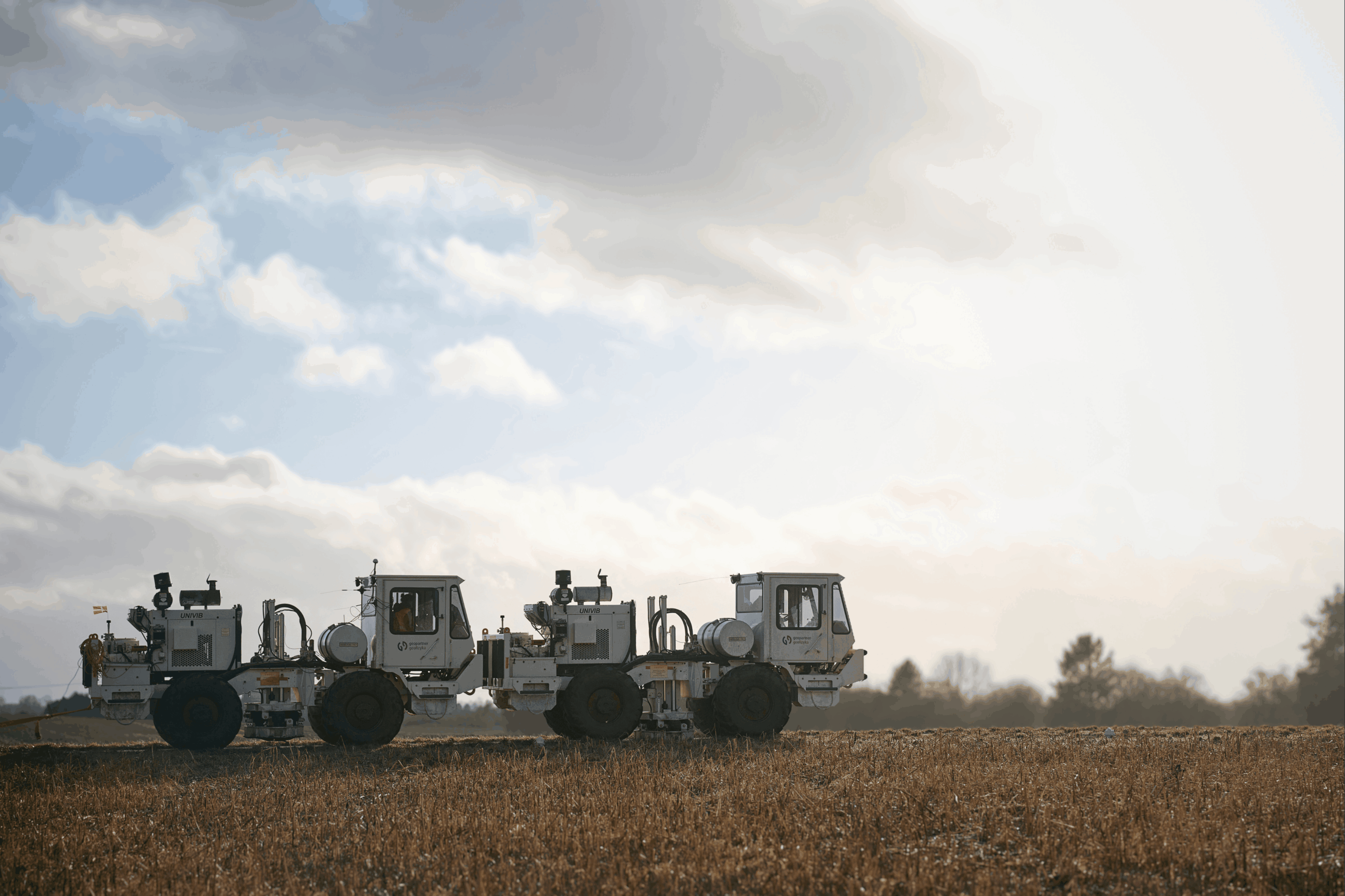
The conditions of Denmark’s subsoil are considered ideal for storing CO₂ onshore and offshore. Suitable reservoirs with a natural sealing layer are found in many areas of the Danish subsoil, and at the right depth interval. This natural advantage allows Denmark to tap into a vast storage potential. A large part of this is in the North Sea, where decades of oil and gas production have provided Denmark with the knowledge and infrastructure to safely and permanently store CO₂.
According to the Geological Survey of Denmark and Greenland, the Danish subsoil holds the potential to safely store the CO2 of many generations. With such abundant space available, Denmark can act as a hub for storing CO₂ from neighbouring countries. By permanently storing CO₂, emissions can be significantly reduced, supporting both Danish and international climate goals.
How CO₂ is safely stored deep underground
To ensure safe and permanent storage, the captured CO2 needs to be injected into geological formations deep underground. The CO2 is typically stored 800 and 3,000 metres below the surface. At this depth, the high pressure turns the CO₂ from gas into liquid, making it easier to store. The subsoil must consist of rock types with enough pore space to allow the CO₂ to spread evenly throughout the structure. Typically, a suitable reservoir will have at least 20% porosity to ensure effective storage. Above the formation, a thick layer of impermeable claystone acts as a natural seal, preventing the CO₂ from escaping. This claystone layer needs to be at least 20 metres thick to ensure secure storage.
Sandstone, which is abundant in the Danish subsoil, is a particularly well-suited type of rock for this purpose. The porous space is typically filled with brine, a concentrated solution of salt water. Injected CO2 will displace and mix with the brine to stay trapped in the porous space, while a small portion will mineralise or dissolve in the brine. However, the formation must have sufficient capacity before it can be used as a reservoir for CO2 storage.
Storing CO₂ in former oil and gas fields
As Denmark moves towards phasing out oil production by 2050, existing fossil infrastructure and decades of expertise are being repurposed. Depleted oil and gas fields in the North Sea are well-mapped and understood, and they often have the ideal geological conditions for CO₂ storage. In fact, CO₂ can be stored much like oil and gas, which remained naturally trapped underground for millions of years. Using pipelines or ships, CO₂ can be transported to depleted oil and gas fields in the North Sea, transforming them from sources of emissions into long-term climate assets.
Denmark is a co-founder and part of the GONE alliance.
The purpose of the Group of Negative Emitters (GONE) is to promote global collaboration on net-negative emissions with the ambition to gather more countries with negative emission targets in the future. The alliance currently consists of founding partners Denmark, Panama, Finland, as well as the new members Suriname, Ethiopia, Sweden, the Netherlands, Kenya, and the initiative CityCDR with its 20 member cities.