Skip to content

Case

Bio-based circular solutions

Biogas

Carbon capture, storage and utilisation

+3

Carbon Capture at small-scale biogas plants

19 November 2026

Solution provider

ProjectZero

ProjectZero is Sønderborg’s cross-sector climate partnership, uniting citizens, businesses, utilities and the municipality to achieve a CO₂-neutral energy system by 2029 - and to serve as a living blueprint for cities around the world.

More from ProjectZero

Want to see this solution first hand?

Add the case to your visit request and let us know that you are interested in visiting Denmark

Challenge

While biogas production enables farmers to turn livestock manure into energy, much of the biogenic CO₂ is still released into the atmosphere. Capturing this CO₂ could unlock significant climate benefits, but carbon capture technologies have traditionally been designed for large industrial facilities, leaving smaller farms with limited options.

Making these technologies accessible at farm level is becoming increasingly important. Agriculture and food systems account for roughly one-third of global greenhouse gas emissions, and pressure to reduce emissions is growing.

Denmark is the first country in the world to introduce a carbon tax on agricultural emissions. Starting in 2030, Danish farmers will pay around €16 per metric ton of CO₂ equivalent emitted, adding a financial incentive to the urgent need for efficient, affordable solutions that can help farmers reduce their climate impact.

Solution

At Gråsten Agricultural College in Denmark, technology companies Welltec and GreenFarm have developed and tested a modular carbon capture system designed specifically for smaller, decentralized facilities.

The farm operates a biogas plant powered exclusively by manure from its own livestock: 200 cows and 400 sows. The carbon capture technology is housed in a compact 20-foot container and captures biogenic CO₂ directly from the plant’s flue gas.

Supported by Denmark’s Energy Technology Development and Demonstration Program (EUDP), the project brings together technology providers, researchers, and infrastructure partners to demonstrate that efficient carbon capture is possible beyond large industrial facilities.

Growing ideas beyond the farm

Carbon capture from biogas is just one of several innovative projects at Gråsten Agricultural College, where insights are openly shared to inspire others.

Result

The technology has shown promising potential for capturing the majority of CO₂ in the flue gas. When put into operation in 2027, the system is expected to capture 1.5 metric tons of CO₂ per day. This marks a significant breakthrough for small-scale carbon capture, demonstrating that high capture efficiency is achievable even at the farm level.

The next step is to move from successful testing to practical implementation. Starting in 2027, the goal is to begin capturing CO₂ for permanent geological storage beneath the North Sea seabed.

The results could be a game changer for agricultural decarbonization. By making carbon capture accessible to smaller, decentralized biogas plants, the technology could enable farms to go beyond energy production and become active contributors to permanent carbon removal – potentially opening up new business opportunities for farmers.

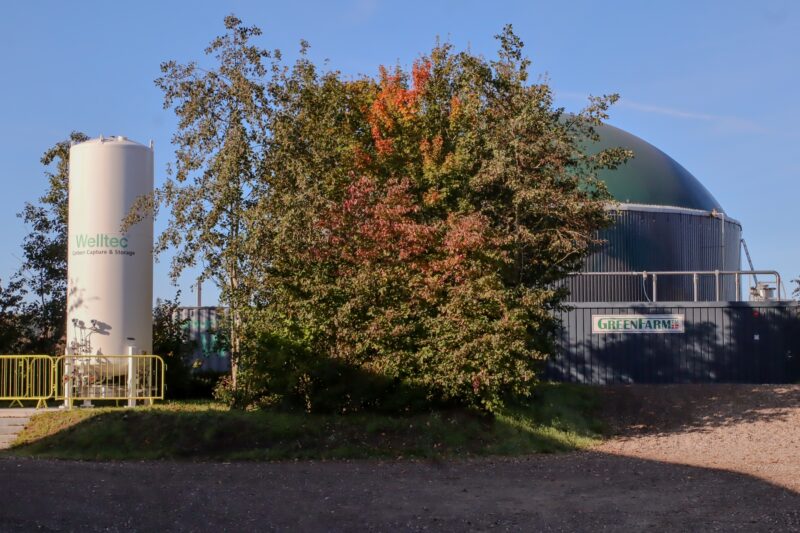
The CO₂ tank

Once captured and stored in this tank, the CO₂ can either be put to use or stored underground.