Skip to content

Perspective

Climate partnerships

Partnerships

Policy frameworks

A new model for public-private climate action

The private sector plays an important role in the effort to achieve the Danish government’s climate goal. Partly via efforts to reduce emissions in value chains. And partly by developing new products, services, technologies, and business models which support the green transition – both at home and abroad.
Climate Partnership Playbook thumbnail

The Climate Partnership Playbook

While public-private partnerships are not without their challenges, the urgent need for climate action unites the public and private sector in achieving a shared goal.

Denmark’s Climate Partnerships show how public and private sectors can supercharge climate action together. This Playbook shares key insights to help replicate successful collaboration models globally.

Discover the playbook

Sector-specific recommendations

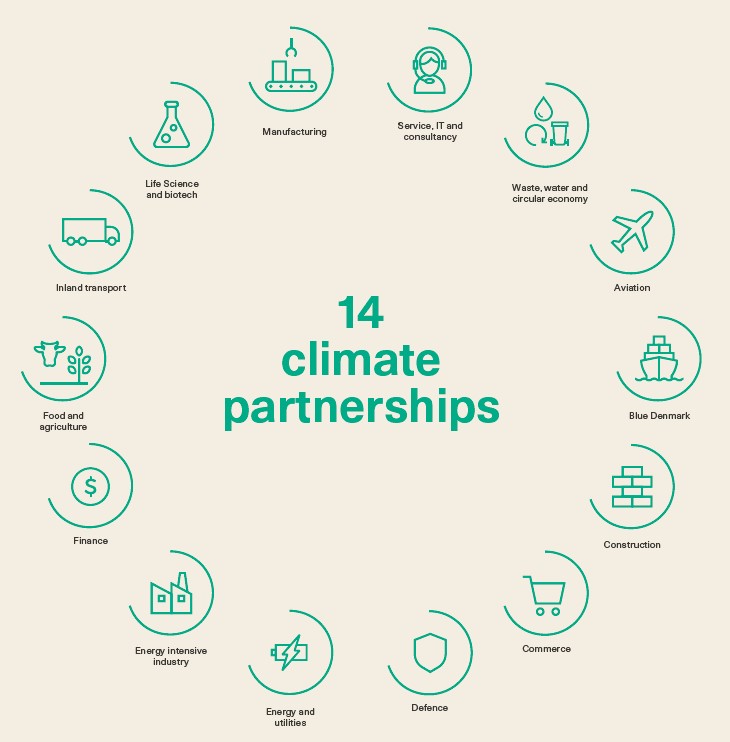
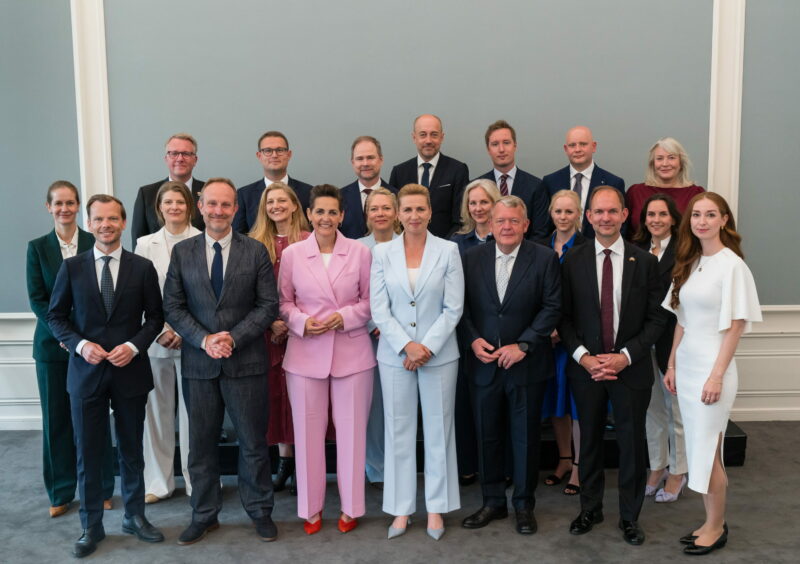
Building on the Danish tradition for public-private partnerships and recognising the private sector as a central actor, the Danish government formed 14 climate partnerships in 2019, each representing a different sector in the Danish economy. The 14 partnerships were tasked with presenting a proposal on how their individual sector could contribute to CO₂e reductions in a just way, supporting Danish competitiveness, exports, jobs, welfare and prosperity.  

The proposal had to include measures that the sector itself could adopt to reduce emissions as well as political recommendations to remove regulatory barriers and improve framework conditions in order to support reductions and green competitiveness.  

This resulted in more than 400 tangible recommendations, many of which are now being integrated into actual policy initiatives – for instance, on carbon capture technologies, electrification efforts and new financial models. 

Benefits of climate partnerships

The benefits of climate partnerships between private and public actors are manyfold and tangible. The ability to demonstrate these benefits is a critical first step to unlocking the potential of future green partnerships all over the world.

Engagement: The private sector emphasises its commitment to establishing long-term climate targets.

Innovation: New technological solutions and business models are unlocked in the process of establishing new partnerships and developing recommendations.

Acceleration: Decarbonisation and the development of new technologies are accelerated through concrete initiatives and increased awareness.

Co-creation: Collaboration and co-creation across public and private sectors as well as businesses and industries, towards one common goal.

Learn more about the Climate Partnerships

Organisation of the partnerships

Each partnership was chaired by a representative from a private sector company appointed by the Danish government, with 1-2 business organisations serving as secretariats. The number of stakeholders involved varied from partnership to partnership due to different structures. Typically, the drafting of the recommendations has been an open process involving several companies and organisations from the entire sector.

Publication frontpage

Discover the publication

This article is a part of the publication “Towards a sustainable industry”. Featuring in-depth cases and insights from key Danish players, the white paper offers a toolbox of ideas, technologies, and frameworks for a green transition.

Explore the white paper

You should consider reading

Climate partnerships
Partnerships
Policy frameworks