Solution provider

We are a value-driven, multi-disciplinary engineering consultancy fundamentally committed to sustainable progress and service delivery.
case
Non-revenue water
We are a value-driven, multi-disciplinary engineering consultancy fundamentally committed to sustainable progress and service delivery.
Add the case to your visit request and let us know that you are interested in visiting Denmark
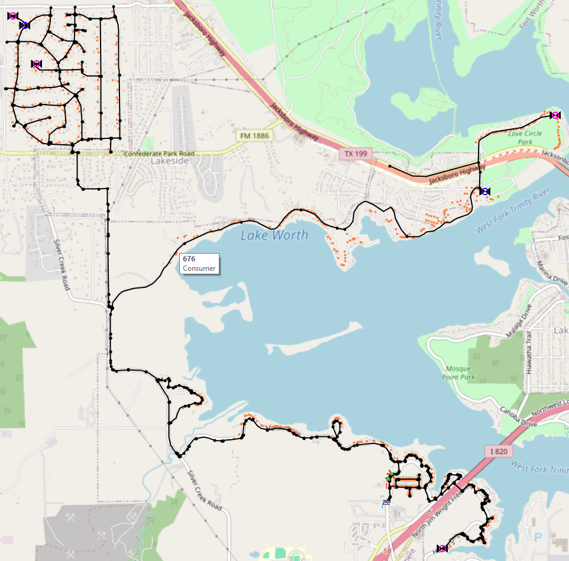
The City of Fort Worth in Texas, with a population of nearly one million, has invested significantly in smart water metering technologies to aid in address high levels of NRW. In 2022 alone, the city reported water losses of around 6.54 billion gallons. Although an advanced metering system was in place, the utility faced challenges in using the high-resolution automated meter reading data to
produce reliable water loss calculations. The inconsistencies stemmed from data noise, operational complexities and unmeasured activities dominated by routine flushing of the network.
To support Fort Worth’s Water Department, Danish consultancy NIRAS conducted a feasibility study focused on the Turtle Creek DMA, a low-density area requiring frequent flushing to maintain water quality requirements. The analysis revealed that inaccuracies in flushing data – both from overactive auto-flushing and unmetered manual flushing – were distorting water loss figures. NIRAS developed and demonstrated a methodology to integrate advanced metering infrastructure consumption data with work orders and operational records, before applying outlier filtering to improve data accuracy and water balance assessment combined with a dynamic rolling averaging to trigger leak alarms. Additionally, customer-level demand data was used to build a detailed water quality model to optimise flushing based on targeted water age.
The approach enabled Fort Worth to improve the accuracy of its water loss reporting and identify opportunities for operational savings. The city estimated that flushing volumes could be reduced by up to 20 percent, supporting both resource efficiency and long-term water quality objectives.
This case is part of our publication ‘Reducing urban water loss’.
Download the publication