Solution provider

We are a value-driven, multi-disciplinary engineering consultancy fundamentally committed to sustainable progress and service delivery.
case
Non-revenue water
Digital water solutions
Water management
We are a value-driven, multi-disciplinary engineering consultancy fundamentally committed to sustainable progress and service delivery.
Add the case to your visit request and let us know that you are interested in visiting Denmark
With a population nearing one million, the City of Fort Worth, Texas, faces a growing need to manage its water resources effectively. In 2022, the city reported a total water loss of approximately 6.54 billion gallons. While significant investments had been made in Automated Meter Reading (AMR) and Advanced Metering Infrastructure (AMI), turning these high-resolution data streams into actionable insights for water loss reduction and water quality management proved challenging. Specifically, the utility struggled to derive consistent and valid results from the smart meter data, partly due to data noise and unmeasured operational activities like flushing.
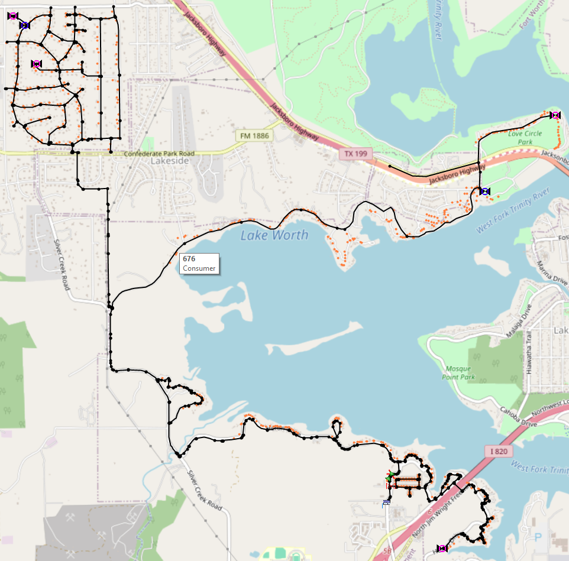
To support the City of Fort Worth in improving the use of its AMI data, Danish engineering consultancy NIRAS conducted a feasibility study focused on the Turtle Creek District Metered Area (DMA). This area consists of 674 connections spread over 36 km of pipeline, requiring both automated and manual flushing to maintain water quality.
NIRAS identified that inconsistencies in flushing data were a primary contributor to the city’s difficulties with accurate water loss reporting. One automated flusher was configured with an excessively high critical flow rate, while manual flushing was not metered, relying instead on estimates logged in work order systems.
To address this, NIRAS developed a new methodology that integrates AMI consumption data with flushing records. This included:
Additionally, the high-resolution customer consumption data was used to build a one-to-one water quality model. This allowed for accurate simulation of water age at each customer connection and informed a flushing optimization strategy targeting a maximum water age of four days.
The collaboration resulted in a practical methodology for accurately calculating water loss by integrating AMI data with operational records. This enabled the City of Fort Worth to benchmark its water loss performance indicators more reliably and with improved precision. Through the flushing optimization model, the city identified the potential to reduce flushing volumes by approximately 20 percent, contributing to more efficient water use. Furthermore, the project demonstrated how detailed, high-resolution consumption data can support both water loss control and water quality management, ultimately strengthening the utility’s ability to manage non-revenue water.