Solution providers

Case
Non-revenue water
Add the case to your visit request and let us know that you are interested in visiting Denmark
Nine Danish partners formed a consortium with the objective of demonstrating the use and effect of integrated high-end solutions within water loss control based on Danish technologies and know-how. The nine partners included leading technology providers, consultants, water utilities and the Technical University of Denmark. Known as the LEAKman Project, its aim was to deliver a sole, holistic NRW management system. Demonstration of a combined leakage management approach Initiated in 2016, the five-year project that was financed under the auspices of the Environmental Technology Development and Demonstration Programme that is supported by the Ministry of Environment, had an overall budget of EUR 5.7 million.
The project included several central aspects such as economic analysis of the ROI, the EEL, selecting appropriate KPIs for monitoring the status and effect of different leakage management solutions as well as the implementation of interfaces between systems. The approach integrated the four key elements of leakage management: pressure management, active leakage control, pipeline management and rehabilitation as well as speed and quality of repairs.
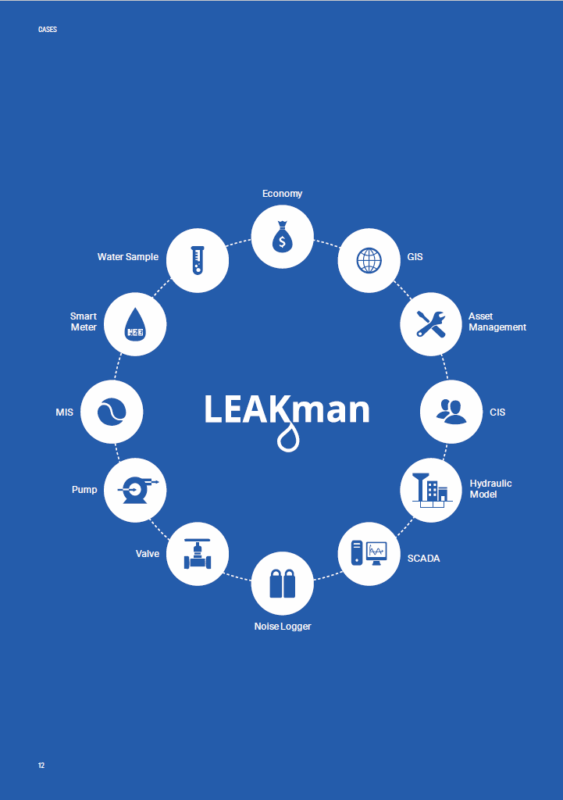
Two large-scale demonstration facilities were established at the Danish water utilities Novafos and HOFOR. The implementation included installation and use of intelligent valves, pumps, deployed noise loggers, smart meters, smart inspections, SCADA, online hydraulic modelling (Aquis), GIS and a holistic management information system (HOMIS) configured for automated calculation, display and reporting of selected key performance indicators.
Integration and connectivity are key Many of these components are generally already in use at water utilities, however, they are often installed as part of separate projects, with only little or inefficient interface between the different components. Consequently, the full potential of the entire system is never reached. The LEAKman Project combined several smart systems and seamlessly integrated and monitored them holistically, thereby connecting the entire water distribution network.
The result of the LEAKman Project was the development of an integrated solution that facilitates water loss reduction to less than 20 percent for any system within just a few years with possible reductions to below 10 percent. In 2020, upon completion of the demonstration facilities, the pressure was reduced by 16 percent in the first demonstration area. An additional reduction of 15 percent is planned. Consequently, a corresponding decrease in leakage level and burst frequency is expected.

This case is part of our publication ‘Reducing urban water loss’.
Download the publication