Skip to content

Case

Buildings

Building design

Building materials

+3

Living Places Copenhagen

22 September 2025

Solution provider

VELUX

For more than 80 years, the VELUX Group has created better indoor environments by bringing daylight and fresh air into buildings all over the world. Our products help create bright, healthy, and energy-efficient places to live, work, learn and play in.

More from VELUX

Want to see this solution first hand?

Add the case to your visit request and let us know that you are interested in visiting Denmark

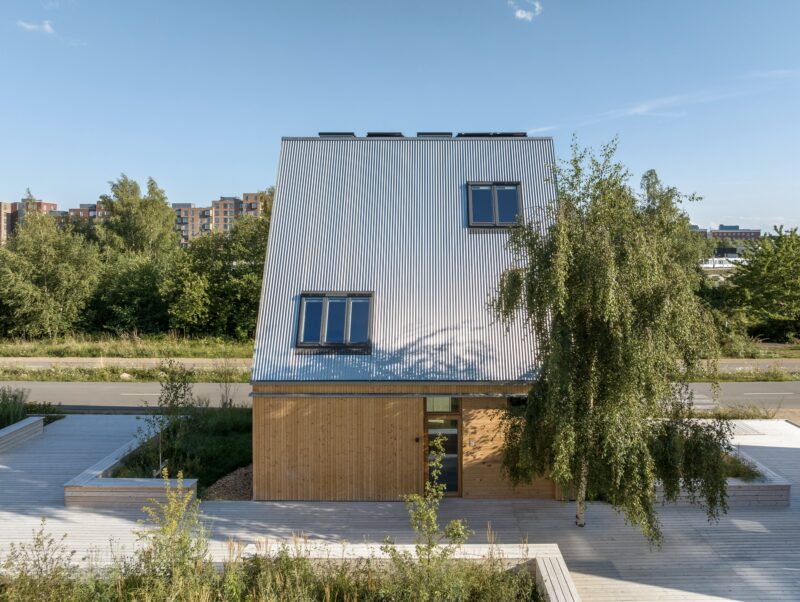
Photo credit: Adam Mork

Challenge

The Living Places concept tackles one of the construction industry’s most pressing challenges: its significant contribution to global CO₂ emissions and resource consumption.

Today, buildings account for a large share of climate impact, and current metrics—such as CO₂ per m²—often incentivise building larger homes, unintentionally accelerating the crisis.

The case addresses how to drastically reduce whole‑life carbon emissions while maintaining affordability, scalability, and a healthy indoor climate. It also responds to the need for circularity by designing for disassembly and reuse, and for new measurement frameworks that encourage right‑sizing and responsible material use.

In short, it demonstrates that with existing technologies and materials, it is possible to build homes that are low‑carbon, healthy, and adaptable—without compromising quality or cost. 

Solution

Living Places is built on a people‑ and planet‑first approach, using full lifecycle assessment (LCA) to guide decisions on reducing emissions across all building phases.

It focuses on bio‑based and low‑carbon materials, material efficiency through optimised floor areas, and prefabricated elements to minimise waste.

The concept integrates energy‑saving design – such as optimised orientation, daylight, and shading—with efficient systems like heat pumps, motion‑controlled lighting, and water‑saving fixtures.

Renewable energy sources and certified materials with Environmental Product Declarations (EPDs) are prioritised, alongside strategies for adaptability and disassembly to enable circularity.

Methodologically, it advocates shifting from measuring “CO₂ per m²” to “CO₂ per person” to encourage right‑sizing and better societal outcomes.

Result

The concept delivers a significant performance leap: approximately 65 percent lower lifecycle CO₂ emissions over 50 years compared to a benchmark house, with an operational footprint of about 3.85 kg CO₂e/m²/year – three times lower than Denmark’s 2023 building regulation.

These calculations are third‑party verified by BUILD at Aalborg University. In 2024, the Copenhagen prototypes continued as a living lab, hosting 96 residents to monitor real‑life performance and user experience.

After the test period, the homes were carefully disassembled for reuse, documenting learnings on circularity while the concept advanced through new partnerships.

Living Places - Inspiring sustainable change worldwide

The original project in Copenhagen is now the basis for projects and builds in the Netherlands, Ukraine and the UK, with more to follow.

Learn more about the partnerships

Denmark at COP30

This case is part of the Denmark Pavillion at COP30 in Bélem, Brazil. Discover more projects, activities and connect with solution providers at the official Danish representation at the UN Climate Change Conference 2025.

Discover Denmark at COP30