Solution provider

Ramboll is a leading international architecture, engineering, and consultancy company, owned by the Ramboll Foundation.
Case
Waste-to-energy
Ramboll is a leading international architecture, engineering, and consultancy company, owned by the Ramboll Foundation.
Add the case to your visit request and let us know that you are interested in visiting Denmark
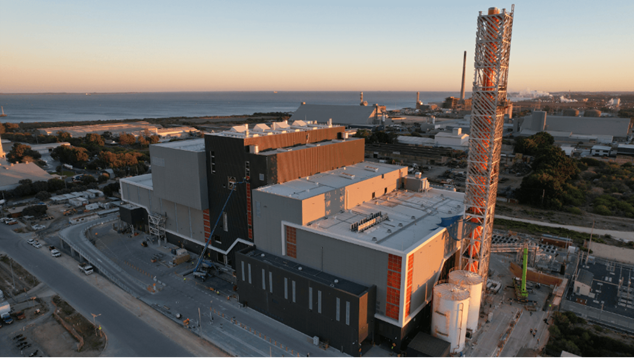
Photo credit: Kwinana Energy Recovery Team
Australia generates more than 70 million tonnes of waste annually. While around 60% is recycled, the remaining 40% is typically sent to landfills, where it contributes to methane emissions and long-term environmental impacts. At the same time, Australia’s energy system remains heavily dependent on fossil fuels, which accounted for approximately 93% of energy supply in 2019.
Reducing landfill volumes while producing low-carbon energy requires infrastructure that can safely recover energy and materials from non-recyclable waste, while meeting strict environmental and regulatory requirements. Prior to the Kwinana project, Australia had no large-scale waste-to-energy facilities in operation.
The waste-to-energy facility in Kwinana, south of Perth, Western Australia, is Australia’s first large-scale plant of its kind. The facility processes up to 460,000 tonnes of municipal and commercial non-recyclable waste annually – equivalent to around 25% of Perth’s residual waste – and converts it into energy and recoverable materials.
Ramboll was appointed by Avertas Energy – co-developed by Macquarie Capital and DIF and later acquired by Acciona – as technical advisor and Owner’s Engineer. Ramboll’s responsibilities included process technology oversight, support during environmental permitting, and technical advisory services during the planning phase, including negotiations of the engineering, procurement and construction (EPC) contract.
As Owner’s Engineer, Ramboll conducted design reviews, inspections during manufacturing and construction, and oversight of testing, commissioning, and handover to commercial operation. Ramboll also acted as environmental advisor, assessing air quality and evaluating reuse and disposal options for residues generated by the facility.
The plant uses well-established grate-based waste-to-energy technology, widely deployed in Europe, where thermally treated waste generates steam for electricity production while enabling metal recovery. A multi-stage flue gas cleaning system and continuous emissions monitoring ensure compliance with environmental standards set by the Western Australian Government.

Ramboll is the Owner’s Engineer for Australia’s first large-scale waste-to-energy facility in Kwinana. The facility will power up to 58,000 homes and has the potential to reduce CO2 emissions by more than 460,000 tonnes annually.
The facility opened in December 2025.
This pioneering facility will:
The Kwinana facility began operations in December 2025. It generates 38 MW of electricity, supplying power to up to 55,000–58,000 homes, while diverting large volumes of waste from landfill. Each year, more than 10,000 tonnes of metals are recovered for recycling.
By avoiding landfill methane emissions and displacing fossil-based electricity, the facility has the potential to reduce CO₂ emissions by more than 460,000 tonnes annually. In its first three months of operation alone, approximately 90,000 tonnes of CO₂ – equivalent emissions were avoided. On average, an estimated 0.8-1.0 tonne of CO₂ is saved for every tonne of waste diverted from landfill.
The Kwinana waste-to-energy facility demonstrates how residual waste can be integrated into a circular energy system, reducing emissions while supplying reliable power. It provides a reference point for future waste-to-energy projects in Australia and contributes to the country’s transition towards a more diversified and lower-carbon energy mix.