Skip to content

Case

Biogas

Carbon capture, storage and utilisation

From biogas to net-negative emissions and beyond

17 February 2026

Solution provider

BioCirc Group

BioCirc owns and operates eight biogas plants in Denmark, representing one of the largest biogas productions globally, and with several plants in the pipeline, we expect to continue our growth in the years ahead.

More from BioCirc Group

Want to see this solution first hand?

Add the case to your visit request and let us know that you are interested in visiting Denmark

Photo credit: BioCirc

Challenge

During biogas upgrading, large volumes of highly concentrated biogenic CO₂ are separated from the methane stream. Traditionally, this CO₂ has been released through chimneys, despite it already being concentrated and purified as part of the biogas upgrading process.

While biogenic, these emissions represent a missed opportunity to actively remove carbon dioxide from the atmosphere at a low cost. At the same time, Denmark’s climate goals increasingly depend on large-scale negative emissions. These emission reductions cannot be achieved solely through measures like electrification, e-fuels, and energy efficiency.

The challenge is not the capture technology itself, but how to integrate carbon capture across multiple decentralised plants, connect them to safe geological storage, and create a scalable and economically viable value chain for permanent carbon removal, all while the infrastructure is still being established.

Solution

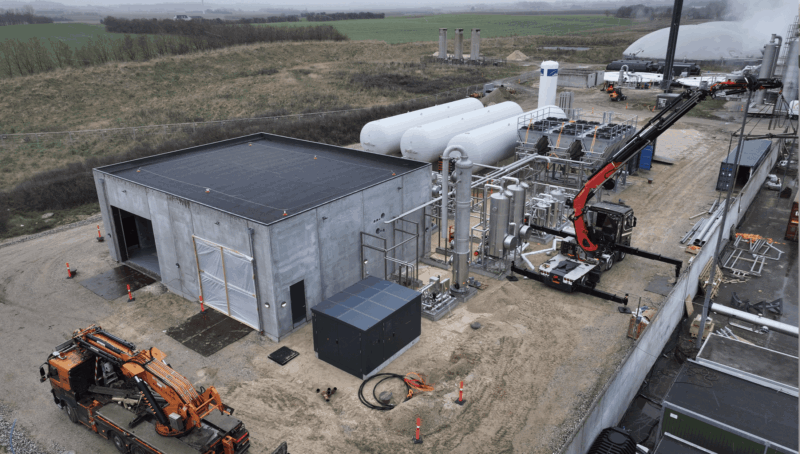
BioCirc is currently implementing carbon capture units at five existing biogas plants, beginning with the facility in Favrskov. Here, the CO₂ that is already filtered out during gas upgrading will be further purified and then liquefied, rather than being emitted. As each site is commissioned, the captured CO₂ will be transported to the Greensand Future project in the Danish North Sea, where it will be injected 1,500–1,800 metres beneath the seabed in the Nini West reservoir for permanent, geological storage.

Supported by the NECCS fund from the Danish Energy Agency, the project establishes a complete CCS value chain from decentralised capture to offshore storage. By leveraging the purity of biogas’ CO₂ streams, the solution represents one of the most cost-effective forms of carbon capture available and demonstrates how biogas facilities can function as carbon removal sites.

Result

From 2026 to 2032, the project is expected to capture and store close to 1 million tonnes of CO₂. BioCirc is expected to become the first company in Denmark, where a biogas plant delivers permanent carbon removal. The first biogenic CO2 is expected to be stored in summer 2026.

BioCirc is set to become the largest supplier of biogenic CO₂ to Greensand Future, contributing to what is expected to be the EU’s first full-scale CO₂ storage facility. The project also enables the commercialisation of verified Carbon Dioxide Removal (CDR) credits, creating a scalable business model for negative emissions and measurable value for municipalities, industry, and national climate goals.