Skip to content

Perspective

Energy efficiency in industry

Air pollution from industry production

Green financing

+5

The global imperative: Energy

As demand for industrial goods grows, so does the need to rethink industrial energy consumption. With global energy demand rising and emissions climbing, industry must use less, waste less, and switch to renewable energy to achieve climate goals.

In too high demand

Global industrial activity has surged over the past two decades, fuelled by rising demand for industrial goods from an expanding population and a growing economy. Since 2000, industrial CO₂ emissions have risen by around 70 percent, and today, industry is responsible for about a quarter of energy-related CO₂ emissions globally. To curb this trajectory, the consumption of energy and related resources must be addressed.   

Industry currently accounts for 37 percent of global energy use, nearly 70 percent of which still stems from fossil fuels. According to the International Energy Agency (IEA), industrial energy demand is expected to increase in coming years at a rate significantly higher than what is aligned with the Net Zero Emissions by 2050 (NZE) Scenario. Thus, the sector must both cut energy use and switch to greener sources.  

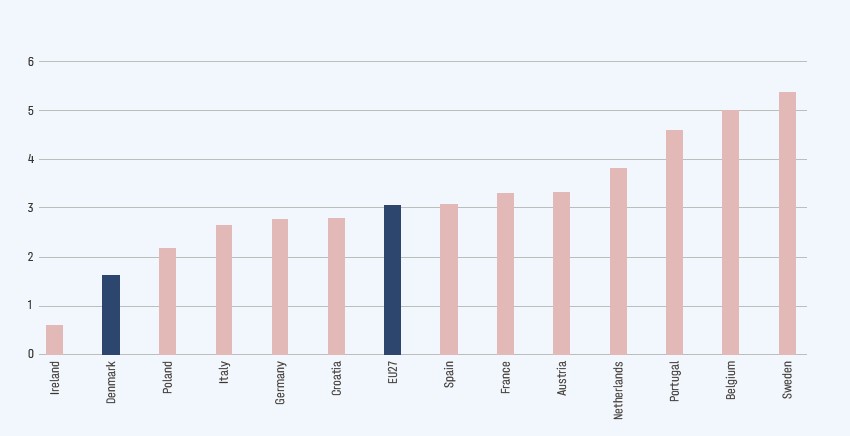
Energy intensity in industry, TJ per million EUR (2023)

Danish industry boasts one of the lowest rates of energy intensity among European countries, at approximately half the intensity of the EU27 average. This is in part due to concerted efforts by industry – incentivised through regulation, financing and increased awareness. This effort has reduced energy intensity in industry by 37 percent since 2000, by 19 percent since 2010, and the quest for improving energy efficiency continues.

Source: ODYSEE-MURE

Energy intensity in industry - illustration from the white paper

Efficiency, integration & electrification

Dubbed the “first fuel” in clean energy transitions, energy efficiency is the largest measure to curb energy demand in the IEA NZE by 2050 scenario. By reducing the amount of energy required to provide products and services, industry can reduce their climate footprint in a cost-effective manner.   

Also, industry has a crucial opportunity to reduce its energy waste. For instance, the amount of heat wasted in the EU industry corresponds to the heat demand of 10 million single-family households. By pursuing sector coupling, industry can harness its excess heat using it onsite and ensure that any remaining heat is transported, stored or converted into valuable energy in the future integrated energy system.  

When it comes to replacing fossil energy sources, electrification wherever possible is paramount, as electrified industrial processes are often far more energy efficient. Studies show that most industrial processes can be electrified either directly or indirectly. There is major potential to electrify heat in industries, particularly for temperatures up to 200°C. This is significant, as today, 47 percent of industrial energy is used for process heat, three quarters of which stems from fossil sources.   

Currently, electricity accounts for only 23 percent of global industrial energy consumption. Thus, accelerating the industrial demand for electricity is not only crucial for energy efficiency but also for enabling the transition to renewables.  

Decoupling consumption from growth 

Historically, the emergence of industry has been considered inseparable from the rise of fossil fuels and increased energy consumption. But, since the 1990s, Denmark has managed to grow its industry and increase its GDP by 80 percent while lowering CO₂ emissions by 46 percent and overall energy consumption by 17 percent (2023). Though this is by no means a global trend, the Danish experience suggests the sustainable growth is possible.

Publication frontpage

Discover the publication

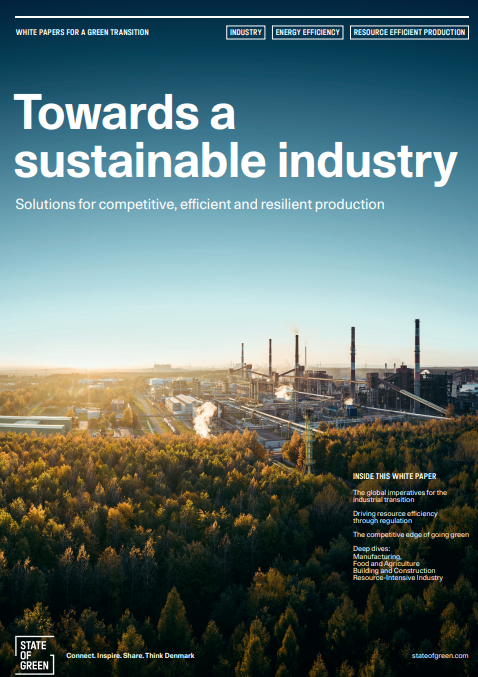
This article is a part of the “Towards a sustainable industry – Solutions for competitive, efficient and resilient production” White Paper. Featuring in-depth cases and insights from key Danish players, the white paper offers a toolbox of ideas, technologies, and frameworks for a green transition.

Explore the white paper

You should consider reading

Air pollution from industry production
Energy efficiency in industry
Green financing
Grid and infrastructure
Job creation and just transition
Policy frameworks
Resource efficient production
Sector coupling