Foreword by

Peter Bakker
CEO, World Business Council for Sustainable Development
Perspective
Energy efficiency in industry
Resource efficient production
Peter Bakker
CEO, World Business Council for Sustainable Development
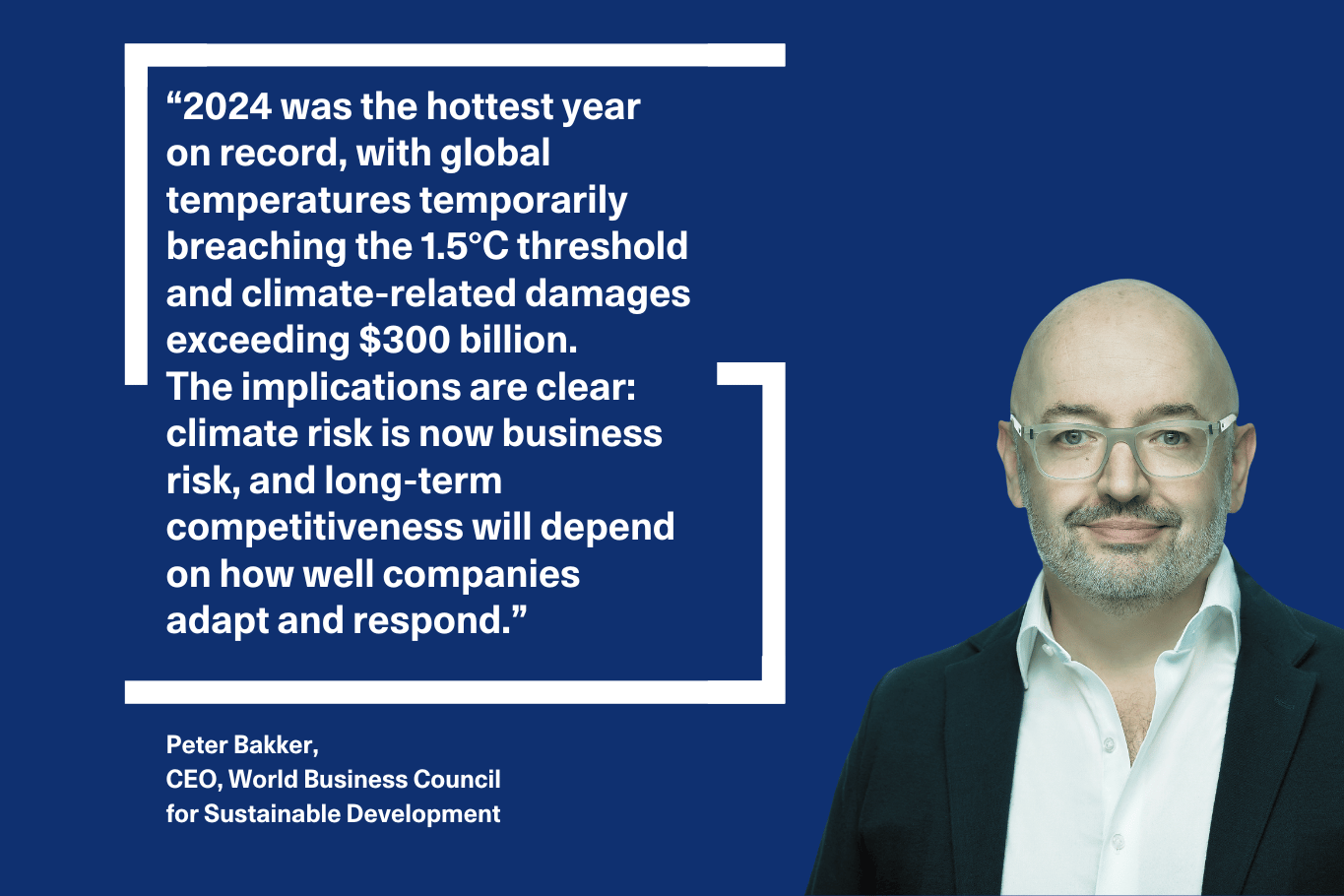
2025 is a year of transition – politically, economically, and industrially. Geopolitical tensions, trade friction, rising climate risk, and diverging regulations are reshaping the context in which business operates. This turbulence is colliding with the reality of physical climate impacts: 2024 was the hottest year on record, with global temperatures temporarily breaching the 1.5°C threshold and climate-related damages exceeding $300 billion. The implications are clear: climate risk is now business risk, and long-term competitiveness will depend on how well companies adapt and respond.
In this context, World Business Council for Sustainable Development’s 2025 Business Breakthrough Barometer provides a real-economy snapshot of where businesses are accelerating action – and why. The data shows a shift: companies are no longer acting just out of compliance or pressure. A majority, 56 percent, now cite long-term competitiveness as the main driver for investing in the transition. They’re acting where conditions support progress: regions with stable policy, affordable clean energy, and growing demand for low-carbon solutions. Businesses are prioritising technologies with dual benefits – commercial viability and climate impact.
But ambition alone is not enough. Fragmentation remains a major barrier across borders, sectors, and value chains. 85 percent of surveyed companies call for stronger international coordination to unlock investment and scale markets for clean technologies. That’s why World Business Council for Sustainable Development is proud to partner with State of Green: to explore how innovative public-private partnerships, like those pioneered in Denmark, can inform global collaboration models.
The road ahead requires credible business leadership, smarter regulation, and financial systems that reward action. No company, government or financier can do this alone. That’s where partnerships matter. World Business Council for Sustainable Development remains committed to building the platforms, coalitions and tools that help businesses turn sustainability into competitiveness—in every region, and at real economy scale.
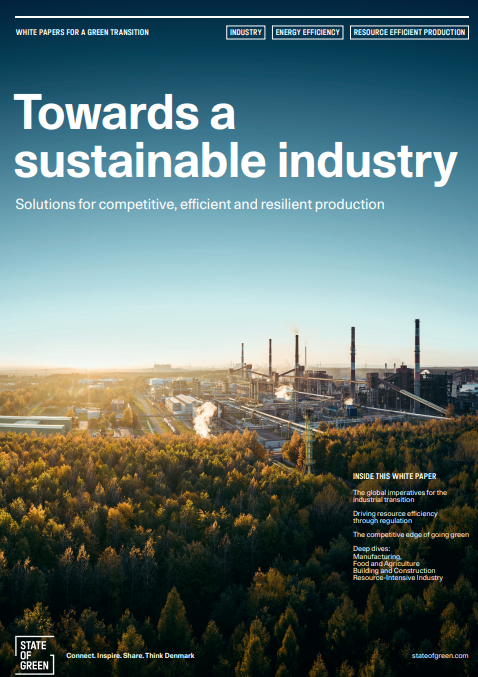
This article is a part of the publication “Towards a sustainable industry”. Featuring in-depth cases and insights from key Danish players, the white paper offers a toolbox of ideas, technologies, and frameworks for a green transition.
Explore the white paper
Solution
Circular business models
+15