Solution provider

DHI is a global leader in water and environmental solutions, leveraging digital innovation, expert consultancy, and advanced modeling to address complex challenges in marine, freshwater, and urban water systems.
Case
Offshore wind
Wind farm planning and development
Wind research and development
+1
DHI is a global leader in water and environmental solutions, leveraging digital innovation, expert consultancy, and advanced modeling to address complex challenges in marine, freshwater, and urban water systems.
Add the case to your visit request and let us know that you are interested in visiting Denmark
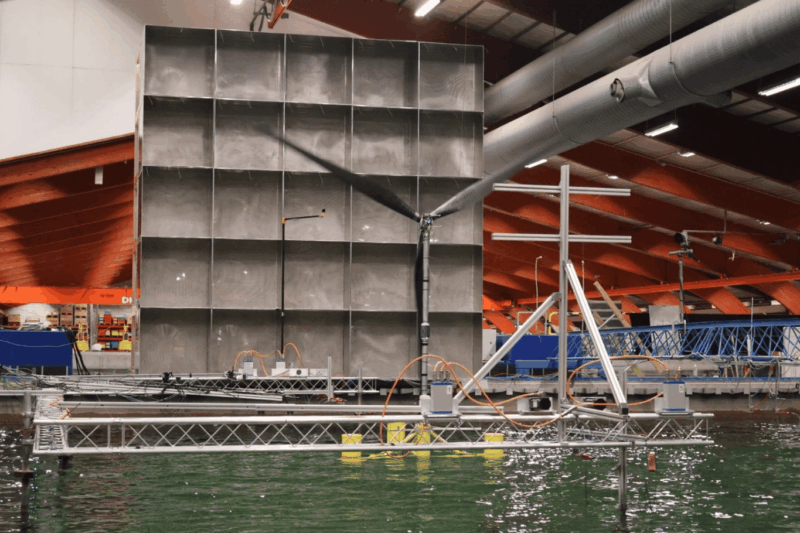
FloatLab offshore wind test center.
As offshore wind moves into deeper waters, floating foundations are expected to play a growing role in the global energy transition. Unlike bottom-fixed turbines, floating wind turbines can be deployed in areas where seabed conditions or water depths make conventional foundations technically or economically challenging. According to Copenhagen Infrastructure Partners (CIP), an estimated 60–80 percent of the global offshore wind potential is located in deep waters, which floating wind technology makes accessible.
However, floating offshore wind introduces new technical complexities. Turbines and foundations are exposed simultaneously to wind, waves and dynamic movements, creating highly complex load conditions that are difficult to model and predict. As turbine sizes continue to increase towards 20+ MW capacity, the need for accurate testing and validation becomes more critical.
At the same time, the floating offshore wind sector remains in an early industrial phase compared to bottom-fixed offshore wind. Reducing costs, improving reliability and accelerating industrialisation requires access to advanced testing facilities capable of simulating real offshore wind conditions before technologies are deployed at sea.
DTU Wind and Energy Systems and DHI have successfully developed and tested the world’s largest open-jet wind generator for floating wind tests. Hear a description from Henrik Bredmose, Professor at DTU, and Pietro Tomaselli, Hydraulic Engineer at DHI.
Video credits: DHI & DTU
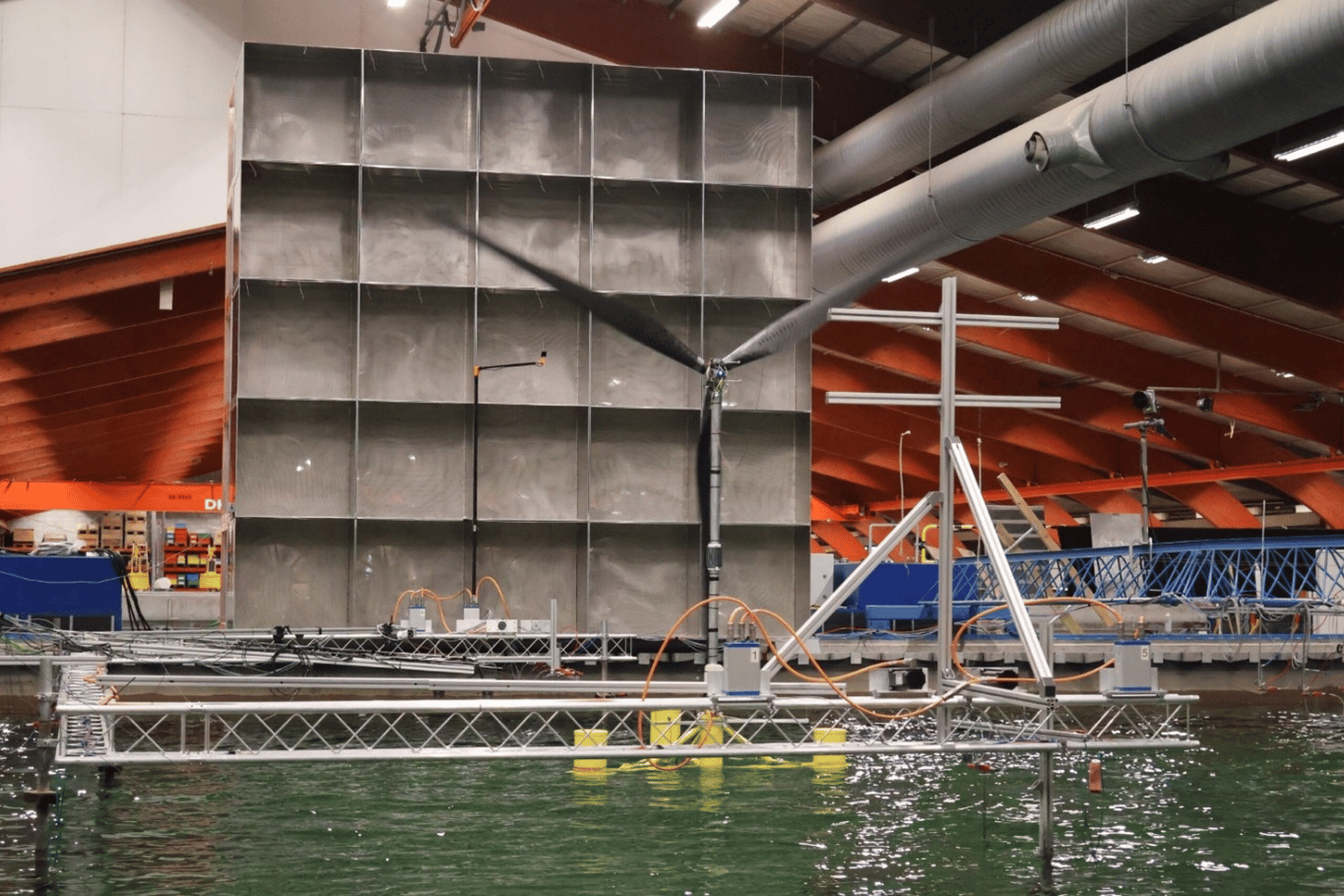
Established in 2023, FloatLab is a Danish research and testing collaboration focused on advancing floating offshore wind technology through targeted physical model tests and numerical modelling. The consortium includes DTU Wind, DHI, Siemens Gamesa, Stiesdal Offshore, STROMNING and Ørsted, with support from Innovation Fund Denmark.
FloatLab uses scaled models of next-generation offshore wind turbines, including concepts based on 22 MW turbines mounted on floating foundations such as the TetraSub design developed by Stiesdal Offshore. Measurements from dedicated experiments are analysed to better understand how the structure responds under wind and waves. The laboratory dataset is also used to improve numerical tools, reducing model prediction uncertainties. Combining physical and digital twin modelling, FloatLab helps reduce cost and risks for floating turbine designs before full-scale deployment.
At the centre of the project is a wave and wind testing facility located at DHI in Hørsholm, Denmark – just outside of Copenhagen. The facility combines a 20 x 30 metre offshore basin equipped with 3D wave generators and one of the world’s largest open-jet wind generators for offshore wind testing.
The wind generator, developed by DHI and DTU Wind, has a 5 x 5 metre outlet and can simulate wind speeds corresponding to storm and hurricane conditions. Together with advanced wave simulations, the facility can recreate the combined forces acting on floating wind turbines in open sea conditions. Waves of up to several metres high can be simulated in the basin, enabling testing under controlled but realistic scenarios.
Knowledge and results from the project are disseminated to industry and research actors in Denmark and internationally through papers and technical publications, helping mature the industry and accelerate the development of floating offshore wind technologies.
FloatLab provides developers, researchers and technology providers with access to testing capabilities designed for the next generation of offshore wind turbines. By enabling realistic modelling of wind and wave interactions, the facility supports faster technology maturation and helps reduce technical and financial risks associated with floating offshore wind projects.
The project also contributes to the broader industrialisation of floating offshore wind. While the technology is still considered less mature than bottom-fixed offshore wind, industry actors expect larger-scale commercial projects to emerge during the 2030s as turbine sizes increase and costs decline.
Floating foundations may also offer environmental advantages in some locations, as they are not fixed directly into the seabed in the same way as conventional offshore wind foundations. This can potentially reduce seabed disturbance, while also expanding opportunities for offshore wind deployment in deeper waters.
Through collaboration between research institutions and industry, FloatLab demonstrates how testing infrastructure can support the transition from prototype development to large-scale deployment of floating offshore wind technologies.