Skip to content

Case

Bio-based circular solutions

Biodiversity

Biodiversity in agriculture

+11

MicrobeXplorer: Xplore the Invisible World of Microbes

10 October 2025

Solution provider

BRIGHT

The Novo Nordisk Foundation Biotechnology Research Institute for the Green Transition (BRIGHT) at the Technical University of Denmark (DTU) aims to provide scalable, bio-based alternatives to fossil-derived products, supporting global efforts to reduce greenhouse gas emissions.

More from BRIGHT

Want to see this solution first hand?

Add the case to your visit request and let us know that you are interested in visiting Denmark

Challenge

At BRIGHT we love microbes. We love them because they are fascinating invisible organisms who each work with a clear target, are highly adaptive to their environment, and are a crucial part of our existence and the shape of our planet.

Solution

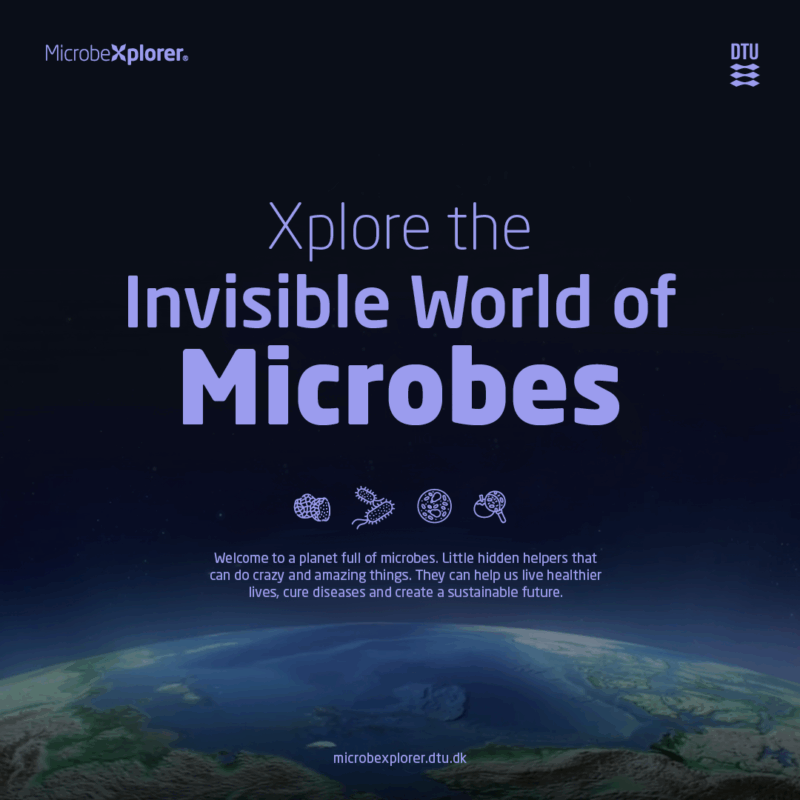
MicrobeXplorer is an interactive website, built by DTU Biosustain (which has come to a close) and now continued by BRIGHT. The site is targeted toward high school students and beyond as a fun and engaging way of acquiring knowledge about microbes.

This is a new way of communicating science to young people and all the curious people at heart. In addition to being fun and engaging, we aim for MicrobeXplorer to be used as a support tool in high school biology, chemistry and biotechnology courses in Denmark and around the world. The site is built in close cooperation with some of our researchers at that time working at DTU Biosustain and now at BRIGHT. We also had guidance from a focus group of local high school students, educators, LIFE Foundation and Experimentarium who provided key ideas and suggestions for us to bring to life.
Result

The main focus of the site is our four microbial worlds to explore:

  • Truffles – describes non-yeast fungi, underground networks, and their application in modern-day solutions.
  • E. coli – introduces the microbe and its cellular composition, synthetic biology, bacterial engineering, gene diversity and putting cell factories to use.
  • Yeast – from the history of yeast, to its fermentation power, to scaling for industrial manufacturing.
  • Food – our failing food system, foods made with microbes, our gut microbiome, and the growing potential of microbial food.

You can also find a glossary, resources for further study and an introduction to some of the exciting careers possible within this scientific field.

If you have any questions or comments, please feel free to contact Vanesa Sánchez-Guajardo, project manager of the site.