Solution provider

We help key industries in the global economy to reduce hard-to-abate emissions.
Case
Heat pumps
Climate COP
District energy
+1
We help key industries in the global economy to reduce hard-to-abate emissions.
Add the case to your visit request and let us know that you are interested in visiting Denmark
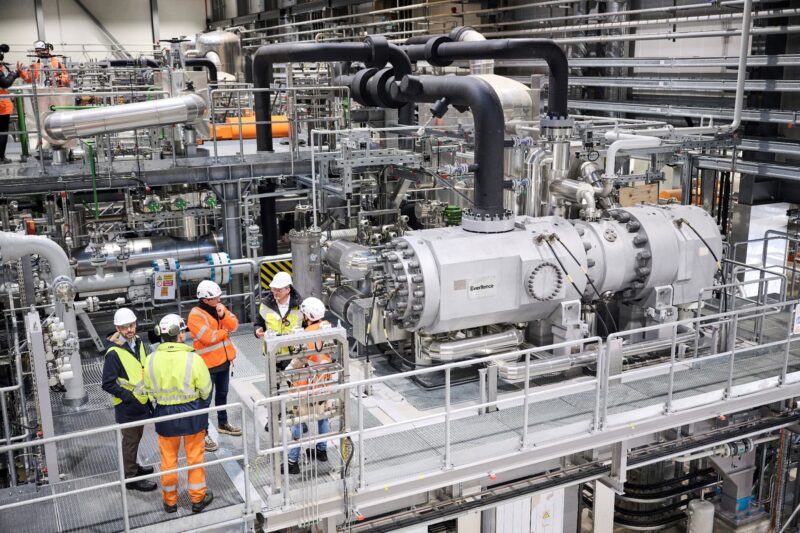
Photo credit: Everllence
For decades, the Danish port city of Esbjerg relied on coal-fired and waste-to-energy plants to heat homes and businesses.
This model was increasingly unsustainable: heating represents more than half of final global energy use and contributes around 40% of CO2 emissions. Locally, the 440 MWth coal plant provided half of the district heating for Esbjerg, Varde, and Fanø, creating significant emissions and dependency on fossil fuels.
As Denmark pursues carbon neutrality by 2045, and Esbjerg by 2030, the need was clear: phase out coal, ensure a stable and affordable heat supply, and integrate growing shares of fluctuating wind power into the energy system.
DIN Forsyning, the local utility, implemented a first-of-its-kind 70 MW seawater heat pump at their facility at Esbjerg Harbor.
Delivered by Everllence, the plant uses two industrial-scale heat pump units with supercritical CO2 as refrigerant. Each unit extracts heat from the Wadden Sea and transfers it to the district heating network at up to 90 °C.
The technology combines high efficiency with operational flexibility, enabling the plant to shift electrical loads and provide ancillary grid services such as automatic frequency restoration.
Powered by offshore wind farms, the system offers fossil-free, cost-effective district heating while enhancing grid stability. It is part of a broader roadmap that also includes biomass and electric boilers to ensure robustness against market fluctuations.


Since start-up in December 2024, the Esbjerg heat pump has replaced the coal-fired CHP plant and now supplies about 280,000 MWh of green heat annually to 25,000 households. This avoids around 120,000 tons of CO2 emissions every year. Initial operation has demonstrated a coefficient of performance above 3 and load-shifting capacity of up to 16 MWe, enabling participation in ancillary service markets. Beyond emissions reduction, customers benefit from stable heating costs decoupled from fossil fuel prices. The project demonstrates how large-scale heat pumps can decarbonize district heating, support integration of offshore wind, and strengthen energy security. As a replicable model, the Esbjerg case provides valuable insights for cities worldwide transitioning away from coal toward sustainable, flexible heating solutions.

This case is part of the Denmark Pavillion at COP30 in Bélem, Brazil. Discover more projects, activities and connect with solution providers at the official Danish representation at the UN Climate Change Conference 2025.
Discover Denmark at COP30