Solution provider

Novonesis is a global company leading the era of biosolutions.
Case
Surplus heat from industry
District cooling
District energy
+2
Novonesis is a global company leading the era of biosolutions.
Add the case to your visit request and let us know that you are interested in visiting Denmark
Photo Credit: Hofor
HOFOR (Greater Copenhagen Utility) supplies district heating (DH) to app. 670,000 customers in Copenhagen. HOFOR wants to have a competitive and CO2-neutral DH supply. Novonesis is a world-leading biosolutions partner, providing among others a wide range of industrial enzymes and microorganisms.
In 2019, HOFOR and Novonesis initiated a cooperation about installing a heat pump with the purpose of utilizing excess heat from Novonesis’ production of enzymes in HOFOR’s district heating network. Both companies have a green strategy where energy efficiency is part of the efforts to reduce the companies’ CO2 emission.
The heat pump helps HOFOR and Novonesis to increase energy efficiency and to reduce costs and CO2 emissions.
Since the heat pump uses electricity as input, which in Denmark is increasingly produced by wind turbines and solar PV, the heat pump also supports sector coupling between the electricity and heat sector. By having different DH production technologies available, including both combined heat and power plants (CHP) and heat pumps, HOFOR can switch between heat production technologies. This reduces costs and CO2 emissions, and it supports the integration of even more wind power and solar PV in the electricity system since there is a correlation between much RE electricity in the system and low electricity prices.
When the heat pump is in operation, Novonesis saves electricity consumption in their conventional cooling towers. Thereby, in addition to reducing costs and CO2 in the district heating system, the heat pump also reduces costs and CO2 from Novonesis’ production of enzymes.
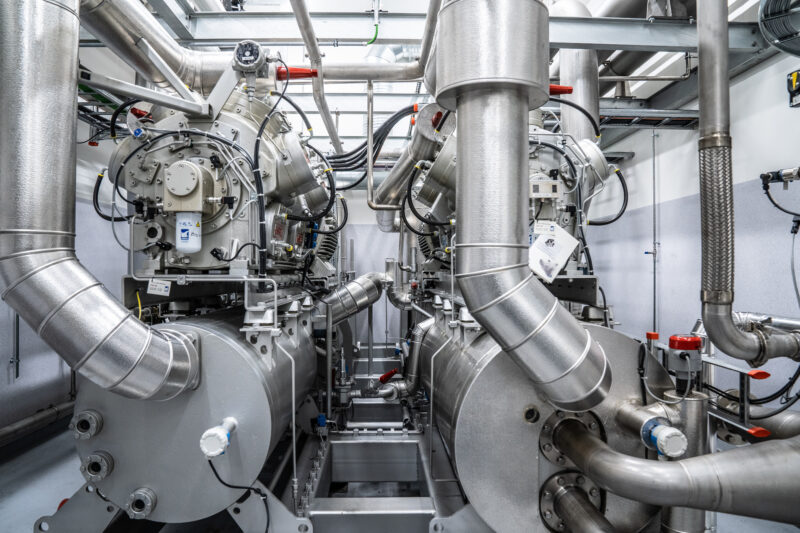
The heat pump, consisting of two compressors, has a total heat production capacity of 4 MW and a total cooling capacity of 3 MW. When operating at full load, the electricity consumption is 1 MW.
On the cold side, the heat pump is connected to Novonesis’ cooling circuit, and on the warm side, it is connected to the district heating network. When the heat pump is in operation, it “moves” energy from the cooling circuit to the district heating network. Thereby, the heat pump produces cooling and district heating at the same time. The refrigerant used in the heat pump is ammonia.
The heat pump can produce up to app. 30,000 MWh district heating and 22,000 MWh cooling per year. The coefficient of performance (relative to heat production) is 3.8 resulting in an electricity consumption of up to 8,000 MWh per year.
The actual production from the heat pump depends on, among other things, the electricity price and thereby the costs of operating the heat pump. During the first four years of operation, the average annual production has been 16,400 MWh district heating and 13,000 MWh cooling.
The produced heat replaces heat production at other heat production units in the Greater Copenhagen DH system. Thereby, the heat pump contributes to a more divers energy- and technology mix in the DH system together with reduced costs.
Apart from reduced electricity consumption in Novonesis’ conventional cooling towers, the heat pump also results in reduced water consumption. The heat pump reduces CO2 emission by 1,000 to 2,000 tons per year. The costs of establishing the heat pump were approximately DKK 35,000,000. At the time of the final investment decision (FID), the simple payback time of the heat pump was estimated to eight years.
This case is a part of the “Towards a sustainable industry – Solutions for competitive, efficient and resilient production” White Paper. Featuring in-depth cases and insights from key Danish players, the white paper offers a toolbox of ideas, technologies, and frameworks for a green transition.
Explore the white paper