Solution provider

DHI is a global leader in water and environmental solutions, leveraging digital innovation, expert consultancy, and advanced modeling to address complex challenges in marine, freshwater, and urban water systems.
Case
Water management
Non-revenue water
DHI is a global leader in water and environmental solutions, leveraging digital innovation, expert consultancy, and advanced modeling to address complex challenges in marine, freshwater, and urban water systems.
Add the case to your visit request and let us know that you are interested in visiting Denmark
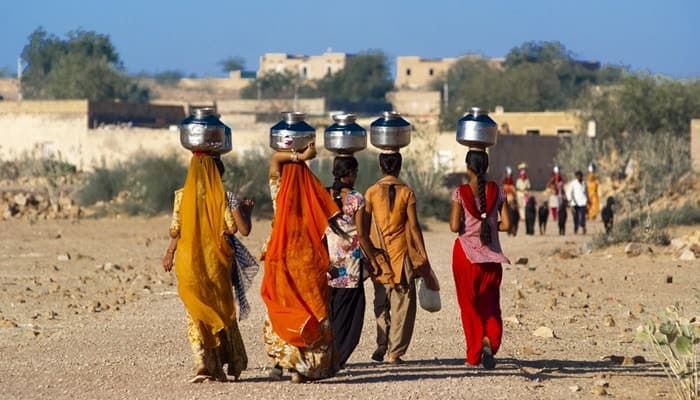
Rajasthan, India’s largest state by area, spans 342,000 km² and is home to over 56 million people. A natural geographical divide, marked by the Aravalli mountain range, splits the state into the arid Thar Desert in the west and a more fertile eastern region. Over 60% of Rajasthan lies within the desert zone, where access to water is limited and unevenly distributed. Rapid urbanisation over recent decades has placed increasing pressure on the state’s water infrastructure.
A study conducted across 222 towns revealed that many urban junctions in Rajasthan’s water network suffer from low water pressure and high head losses. This was due in part to ageing infrastructure, non-optimal system design, and inconsistent supply durations. In some cases, water failed to reach consumers altogether, resulting in intermittent supply and reduced system efficiency.
To assess and improve the performance of Rajasthan’s urban water distribution systems, a four-phase benchmarking process was carried out—comprising model building, model calibration, optimisation, and reporting. This process involved the analysis of a large volume of asset data, including topography, supply quantity, and service duration.
The water modelling software MIKE+ was used to manage and analyse data from all 222 towns. The software enabled full integration of GIS and hydraulic modelling, allowing engineers to visualise and simulate the performance of existing water networks.
Through model calibration, simulated pressures in the network were matched with field measurements. MIKE+ was then used to identify critical points of failure, such as low-pressure junctions and high-friction pipes – referred to as ‘hot spots’ in the system. Hydraulic simulations informed several recommendations to improve network performance, including the installation of new parallel pipelines to reduce friction losses and increase terminal pressure. Additionally, network looping was proposed to further enhance pressure stability in specific areas.
Flowchart indicating the methodology for hydraulic analysis using MIKE+ for 222 towns and cities of Rajasthan
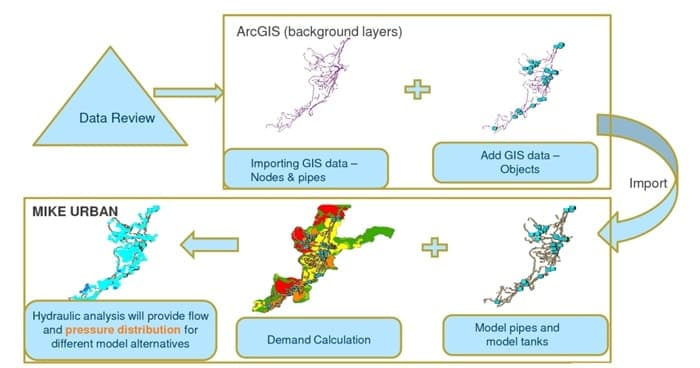
One of the primary challenges was the availability and consistency of data for calibration. Addressing these inconsistencies was essential to ensure the reliability of the hydraulic models. Throughout the study, nearly 3,000 water distribution models were developed for the 222 towns.
The benchmarking process provided the Public Health Engineering Department of Rajasthan (PHED) with a detailed overview of existing network constraints and asset performance. This work helped to identify priority areas for investment and offered a structured approach to long-term infrastructure planning. The insights and hydraulic strategies developed for these 222 towns serve as a reference for future improvements not only within Rajasthan but potentially across other Indian states facing similar distribution challenges.