Solution provider

We are an architectural office specialized in the fields of climate adapted landscapes, hybrid buildings and sustainable urban planning.
Case
Climate change adaptation
Flood prevention
Nature based solutions
+1
We are an architectural office specialized in the fields of climate adapted landscapes, hybrid buildings and sustainable urban planning.
Add the case to your visit request and let us know that you are interested in visiting Denmark
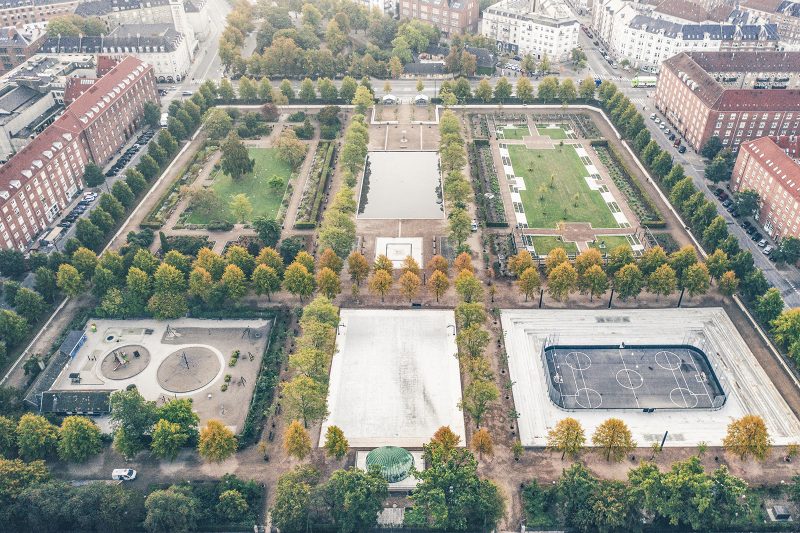
Copenhagen’s Vesterbro neighbourhood sits at the convergence of several topographical and climatic pressures. The historic Enghaveparken — a neoclassical park from the 1920s designed by Danish design icon Arne Jacobsen — occupies a low-lying position at the base of a natural hill, making it a natural catchment point for surface water. As climate-intensified cloudbursts became more frequent across Copenhagen during the 2010s, the area experienced repeated flooding events causing extensive property damage and pressure on municipal drainage infrastructure.
The central challenge was one of competing imperatives: how to embed large-scale urban water management infrastructure — a 22,600 m³ rainwater reservoir — into a protected heritage landscape without erasing the cultural and architectural identity that makes the park a civic landmark. Any intervention had to honour Jacobsen’s neoclassical geometry while making the park functionally resilient to 21st-century climate extremes.
The design consortium — THIRD NATURE, COWI, and Platant — approached the project as an exercise in integrated climate adaptation and cultural preservation, delivering what is now the largest climate infrastructure project in Copenhagen.
9,000 m³ of rainwater storage capacity was created by carefully excavating within the park’s existing neoclassical structure, preserving its geometric axes, tree alleys, reflecting pool, playground, and stage. A further 13,600 m³ of capacity was achieved through a low perimeter wall — or levee — constructed along the park’s boundary. Designed to function as bench seating and play infrastructure during dry periods, the levee serves a dual purpose that keeps the landscape usable year-round.
A key engineering innovation is the automated gate system built into the perimeter wall. In the event of extreme rainfall, the gates close automatically — without requiring electricity — sealing the park as a temporary reservoir and protecting adjacent residential buildings from flood damage. When water levels recede, the park reopens to the public.
Rainwater from nearby rooftops is channelled into a retention basin within the park, where it is stored and redistributed for irrigation during dry periods and street cleaning across Copenhagen. Water also circulates visibly through a channel running along the top of the levee, creating a tactile, interactive feature for visitors, and feeds into a fountain garden designed for children. This visible water cycle creates a sensory and educational connection between urban residents and the city’s water system — linking daily recreation to climate resource management.
The original Arne Jacobsen pavilions were carefully restored and repositioned at the park entrance, and biodiversity was significantly enhanced through the introduction of varied plantings that support urban wildlife including insects and small animals, ensuring year-round ecological and aesthetic value.


Enghaveparken Climate Park is now Copenhagen’s most significant demonstration of climate-adaptive urban design at heritage scale.
The project received the prestigious Danish architecture award Årets Arne — awarded by the Danish Association of Architects to projects that make an outstanding contribution to Danish architectural quality — named in honour of the park’s original designer.
Enghaveparken Climate Park is now internationally cited as a leading case study in climate-positive heritage regeneration, demonstrating that urban climate adaptation and cultural conservation are not competing priorities, but mutually reinforcing ones.