Skip to content

Case

Industrial symbiosis

Energy efficiency in industry

Green supply chains

+1

A symbiosis of wood, waste and energy exchange

24 June 2025

Solution provider

VELUX

For more than 80 years, the VELUX Group has created better indoor environments by bringing daylight and fresh air into buildings all over the world. Our products help create bright, healthy, and energy-efficient places to live, work, learn and play in.

More from VELUX

Want to see this solution first hand?

Add the case to your visit request and let us know that you are interested in visiting Denmark

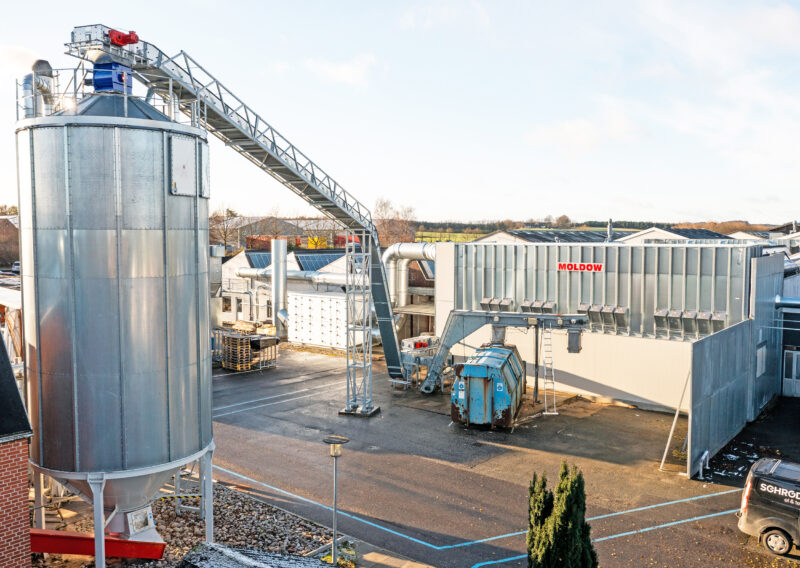
Photo credit: Moldow

Challenge

By 2030, VELUX aims to eliminate their operational (scope 1&2) emissions without using carbon offsets and halve their value chain (scope 3) emissions in absolute terms compared with 2020.  

This requires an ambitious and integrated approach across not just VELUX but also working closely with the value chain.

Solution

The ‘Design for Zero’ programme focuses on ensuring that production processes, production equipment and how it is connected to energy systems on sites, are always designed holistically with highest feasible energy efficiency in mind.  

The production site was upgraded by looking towards local Industrial Symbiosis opportunities with the local Østbirk District Heating company creating mutual economic and environmental benefits by exchanging heat in periods with excess production and by supplying this as renewable heating utilising wood waste (from FSC/PEFC certified forestry) from the local production at Østbirk Bygningsindustri.  

In the winter the VELUX production site imports heat from Østbirk District Heating Company and in the summer months the VELUX production site exports excess heat to cover heat needs in the local community district heating.   

The transition from natural gas to bio-boiler and district heating local symbiosis has led to an annual reduction of 930 tonnes CO2, making Østbirk Bygningsindustri a “Near Zero” CO2 emission production site. 

At the same time, the installation of the bio-boiler also significantly eased the process of disposing of the wood chips, which was previously a cumbersome affair, requiring significant administration. Finally, burning the wood waste on site and selling excess heat as district heating has also been a positive business case  
Case contributors:

Moldow 

Østbirk Varmeværk 

Result

The results have been substantial with less power used for both operation and heating the production area. 

Concretely, via the new chip extraction plant, Velux achieved environmental savings of around 1,000,000 kWh/year​ in electricity (the same as about 200 households of 4 people) and 889,000 kWh/year​ in heat recovery.  In addition, this was the first completely new system in VELUX to be built according to the VELUX energy efficiency standard​, thus setting a blue-print for our work going forward

Publication frontpage

Discover the publication

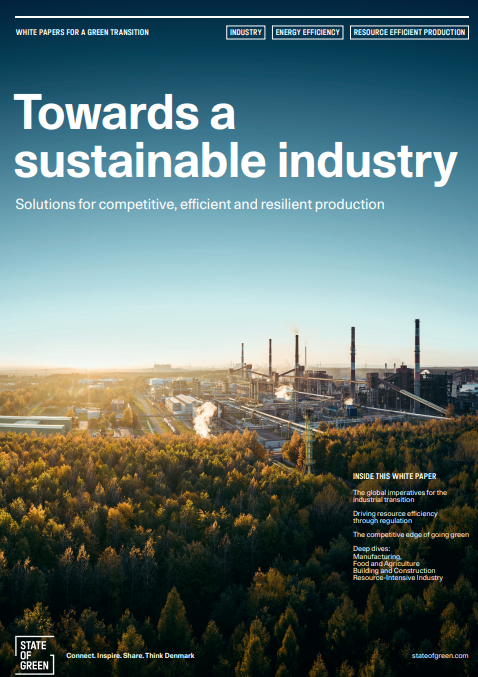
This case is a part of the “Towards a sustainable industry – Solutions for competitive, efficient and resilient production” White Paper. Featuring in-depth cases and insights from key Danish players, the white paper offers a toolbox of ideas, technologies, and frameworks for a green transition.

Explore the white paper